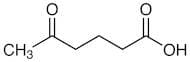
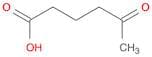
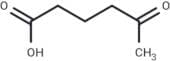
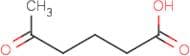
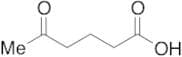
CAS 3128-06-1
:4-Acetylbuttersäure
- 5-Ketocaproic acid
- 5-Ketohexanoic acid
- 5-Ketohexanoic acid~5-Oxohexanoic acid
- 5-Oxocaproic acid
- 5-Oxohexanoic Acid
- Caproic acid, δ-oxo-
- Hexanoic acid, 5-oxo-
- Ketohexanoicacid
- NSC 5281
- γ-Acetylbutyric acid
- δ-Ketocaproic acid
- δ-Ketohexanoic acid
- δ-Oxocaproic acid
- RARECHEM AL BO 0242
- 5-oxo-hexanoicaci
- delta-Oxocaproic acid
- gamma-Acetylbutyric acid
- 5-Oxohexanoate
- delta-Ketocaproic acid
- Weitere Synonyme anzeigen
5-Oxohexanoic Acid
CAS:Formel:C6H10O3Reinheit:>98.0%(GC)(T)Farbe und Form:Colorless to Red to Green clear liquidMolekulargewicht:130.144-Acetylbutyric acid, 97%
CAS:4-Acetylbutyric acid is used in the synthesis of selective indomethacin analogues for AKR1C3 inhibition in the treatment of castrate-resistant prostate cancer. It is also used to prepare PARP inhibitors for the treatment of cancer. This Thermo Scientific Chemicals brand product was originally part o
Formel:C6H10O3Reinheit:97%Farbe und Form:Liquid, Clear colorless to yellow or brownMolekulargewicht:130.144-Acetylbutyric acid
CAS:4-Acetylbutyric acid is a ketone acid widely used in biochemical experiments and drug synthesis research.Formel:C6H10O3Reinheit:99.88%Farbe und Form:SolidMolekulargewicht:130.144-Acetylbutyric acid
CAS:4-Acetylbutyric acid is a monocarboxylic acid that is synthesized from levulinate. It has been shown to be an intermediate in the biosynthesis of amides and 2,6-dihydroxybenzoic acid. The reaction is catalyzed by an enzyme called acetyl coenzyme A synthetase and requires activation energies of −7.5 kJ/mol for the conversion of levulinate to 4-acetylbutyric acid. This organic compound has a kinetic constant of 1.1 × 10 M−1s−1 at 25°C and pH 7, with a pK value of 3.9 at 25°C; it also has amines and carboxylic functional groups, as well as a carbon source requirement.
Formel:C6H10O3Reinheit:Min. 95 Area-%Farbe und Form:PowderMolekulargewicht:130.14 g/mol4-Acetylbutyric Acid
CAS:Kontrolliertes ProduktApplications 4-Acetylbutyric Acid is used in the synthesis of selective indomethacin analogues for AKR1C3 inhibition in the treatment of castrate-resistant prostate cancer. Also used to prepare PARP inhibitors for the treatment of cancer as well.
References Liedtke, A. et al.: J. Med. Chem., 56, 2429 (2013); Zhu, G. et al.: Bioorg. Med. Chem., 20, 4653 (2012);Formel:C6H10O3Farbe und Form:NeatMolekulargewicht:130.14