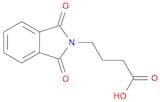
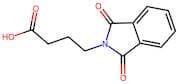
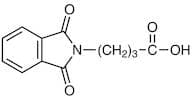
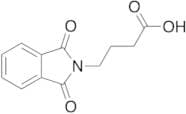
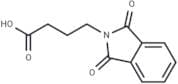
CAS 3130-75-4
:4-Phthalimidbuttersäure
Beschreibung:
4-Phthalimidbuttersäure, mit der CAS-Nummer 3130-75-4, ist eine organische Verbindung, die durch ihre Phthalimid- und Carbonsäure-Funktionalgruppen gekennzeichnet ist. Sie erscheint typischerweise als weißes bis off-white kristallines Feststoff. Diese Verbindung ist bekannt für ihre Rolle als pharmazeutisches Zwischenprodukt und wird häufig in der Synthese verschiedener bioaktiver Moleküle verwendet. Die Anwesenheit der Phthalimid-Gruppe trägt zu ihrer Fähigkeit bei, an verschiedenen chemischen Reaktionen teilzunehmen, einschließlich nucleophiler Substitutionen und Cyclisierungen. 4-Phthalimidbuttersäure ist in organischen Lösungsmitteln wie Ethanol und Dimethylsulfoxid löslich, hat jedoch eine begrenzte Löslichkeit in Wasser. Ihre chemische Struktur ermöglicht die Bildung von Derivaten, die unterschiedliche biologische Aktivitäten aufweisen können, was sie in der medizinischen Chemie von Interesse macht. Darüber hinaus ist es wichtig, diese Verbindung mit Vorsicht zu behandeln und die entsprechenden Sicherheitsprotokolle zu befolgen, da sie Gesundheitsrisiken darstellen kann, wenn sie eingenommen oder eingeatmet wird. Insgesamt ist 4-Phthalimidbuttersäure eine vielseitige Verbindung mit bedeutenden Anwendungen in der chemischen Synthese und der pharmazeutischen Entwicklung.
Formel:C12H11NO4
InChl:InChI=1/C12H11NO4/c14-10(15)6-3-7-13-11(16)8-4-1-2-5-9(8)12(13)17/h1-2,4-5H,3,6-7H2,(H,14,15)
InChI Key:InChIKey=HMKSXJBFBVGLJJ-UHFFFAOYSA-N
SMILES:O=C1C=2C(C(=O)N1CCCC(O)=O)=CC=CC2
Synonyme:- 1,3-Dihydro-1,3-dioxo-2H-isoindole-2-butanoic acid
- 2-Isoindolinebutyric acid, 1,3-dioxo-
- 2H-Isoindole-2-butanoic acid, 1,3-dihydro-1,3-dioxo-
- 4-(1,3-Dioxo-1,3-dihydroisoindol-2-yl)butyric Acid
- 4-(1,3-Dioxoisoindolin-2-yl)butanoic acid
- 4-Phthalimidobutanoic acid
- 4-Phthalimidobutyric acid
- 4-Phthalimidoylbutyric acid
- N-Phthalyl-γ-aminobutyric acid
- NSC 119133
- Phthaloyl γ-aminobutyric acid
- γ-Phthalimidobutyric acid
- 4-(1,3-Dioxo-1,3-dihydro-2H-isoindol-2-yl)butanoic acid
- N-Phthaloyl γ-aminobutyric acid
- 4-(1,3-dioxo-2,3-dihydro-1H-isoindol-2-yl)butanoic acid
- 2H-Isoindole-2-butanoicacid, 1,3-dihydro-1,3-dioxo-
- N-PHTHALIMIDOBUTYRIC ACID
- 4-phthalimidobutyricacid
- 4-phthalimidobuttersaure
- TIMTEC-BB SBB009239
- RARECHEM AL CC 1135
- 4-(1,3-Dihydro-1,3-dioxo-2H-isoindole-2-yl)butyric acid
- 4-(Phthalimid-1-yl)butanoic acid
- 1,3-Dioxo-2-isoindolinebutyric acid
- AKOS BBS-00006541
- AKOS B006361
- CBI-BB ZERO/001688
- 1,3-dihydro-1,3-dioxo-2h-isoindole-2-butanoicacid
- 4-PhthalimidobutyricAcid>
- CHEMBRDG-BB 5107302
- 4-(1,3-Dihydro-1,3-dioxo-2H-isoindol-2-yl)butanoic acid
- 1,3-Dioxoisoindoline-2-butanoic acid
- 4-(1,3-Dioxoisoindol-2-yl)butanoic acid
- 1,3-Dioxo-1,3-dihydro-2H-isoindole-2-butyric acid
- ART-CHEM-BB B006361
- 4-(1,3-DIOXO-1,3-DIHYDRO-ISOINDOL-2-YL)-BUTYRIC ACID
- 1,3-dihydro-1,3-dioxo-2h-isoindole-2-butanoicaci
- 1,3-dioxo-2-isoindolinebutyricaci
- OTAVA-BB BB0125160016
- Weitere Synonyme anzeigen
Sortieren nach
Reinheit (%)
0
100
|
0
|
50
|
90
|
95
|
100
7 Produkte.
4-(1,3-DIOXOISOINDOLIN-2-YL)BUTANOIC ACID
CAS:Formel:C12H11NO4Reinheit:98%Farbe und Form:SolidMolekulargewicht:233.22004-(Phthalimid-1-yl)butanoic acid
CAS:4-(Phthalimid-1-yl)butanoic acidFormel:C12H11NO4Reinheit:≥95%Farbe und Form: off-white solidMolekulargewicht:233.22g/mol4-Phthalimidobutyric Acid
CAS:Formel:C12H11NO4Reinheit:>98.0%(T)(HPLC)Farbe und Form:White to Almost white powder to crystalMolekulargewicht:233.224-(1,3-Dioxo-1,3-dihydro-isoindol-2-yl)-butyric acid
CAS:Formel:C12H11NO4Reinheit:98%Farbe und Form:SolidMolekulargewicht:233.2234-Phthalimidobutyric Acid
CAS:Kontrolliertes ProduktApplications 4-Phthalimidobutyric Acid can be used to evaluate nootropicactivity of newly synthesized gaba derivative in mice.
References Saleem, S., et.al.: Indo Am. J. Pharm., 5, 5527-5547, (2018);Formel:C12H11NO4Farbe und Form:NeatMolekulargewicht:233.22O-Phthalimide-C3-acid
CAS:4-(N-Phthalimidoyl)butanoic acid (compound FB) serves as a hapten featuring a carboxyl group on its terminal spacer arm, enabling reaction with proteins' free amine groups. This property allows its conjugation with carrier proteins, facilitating its use in antigen design [1].Formel:C12H11NO4Farbe und Form:SolidMolekulargewicht:233.223