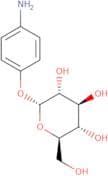
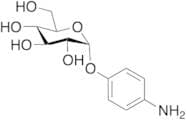
CAS 31302-52-0
:4-Aminophenyl-alpha-D-glucopyranosid
Beschreibung:
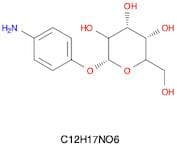
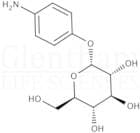
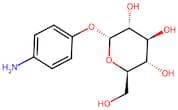
4-Aminophenyl-alpha-D-glucopyranosid ist eine chemische Verbindung, die durch das Vorhandensein einer Aminogruppe und eines Glucopyranosidanteils gekennzeichnet ist. Sie weist einen phenylischen Ring auf, der an der para-Position mit einer Aminogruppe substituiert ist, was zu ihrer potenziellen biologischen Aktivität beiträgt. Der Glucopyranosidanteil zeigt an, dass es sich um ein Glycosid handelt, spezifisch um ein Alpha-D-Glucopyranosid, was bedeutet, dass die Glucoseeinheit in ihrer Pyranoseform vorliegt und über eine glykosidische Bindung mit der Phenylgruppe verbunden ist. Diese Verbindung wird häufig wegen ihrer Anwendungen in der Biochemie und der medizinischen Chemie untersucht, insbesondere im Kontext des Designs und der Entwicklung von Arzneimitteln. Ihre Löslichkeit in Wasser und organischen Lösungsmitteln kann variieren, was ihre Bioverfügbarkeit und Interaktion mit biologischen Systemen beeinflusst. Das Vorhandensein sowohl hydrophiler (Glucose) als auch hydrophober (Phenyl) Komponenten ermöglicht vielfältige Interaktionen, was sie zu einem interessanten Thema in der Forschung zu Enzymsubstraten und -inhibitoren macht. Insgesamt exemplifiziert 4-Aminophenyl-alpha-D-glucopyranosid die Schnittstelle zwischen Kohlenhydratchemie und aromatischen Verbindungen und zeigt die Komplexität molekularer Interaktionen in biologischen Systemen.
Sortieren nach
Reinheit (%)
0
100
|
0
|
50
|
90
|
95
|
100
6 Produkte.
4-Aminophenyl α-D-glucopyranoside
CAS:4-Aminophenyl α-D-glucopyranosideFarbe und Form:White SolidMolekulargewicht:271.27g/mol4-Aminophenyl-α-D-glucopyranoside
CAS:4-Aminophenyl-alpha-D-glucopyranoside is a natural product that has been found to be an antigen. The compound has been shown to have anticancer activity, which may be due to its ability to inhibit the growth of cells and induce apoptosis. 4-Aminophenyl-alpha-D-glucopyranoside also possesses magnetic properties. The chemical structure of this compound is characterized by an acrylate group, which is a small organic molecule with two carbon atoms and one oxygen atom. This compound is synthesized in a preparative manner using methoxy, ethyl bromoacetate, and mesitylene in the presence of irradiation. NMR spectroscopy can be used for the characterization of this compound as well as other compounds with similar structures that are catalytic in nature.Formel:C12H17NO6Reinheit:Min. 98.0 Area-%Molekulargewicht:271.27 g/mol4-Aminophenyl a-D-glucopyranoside
CAS:4-Aminophenyl a-D-glucopyranoside is an alkoxycarbonyl analog that can be used in the preparation of antigens. It is a small, water-soluble molecule that can be used to induce antibody production and to identify antigenic determinants. 4-Aminophenyl a-D-glucopyranoside has been shown to react with glutamicum and corynebacterium cells in vitro. The compound binds to the bacterial cell surface by reacting with amino groups, inducing the production of acid molecules, which leads to bacterial death. 4-Aminophenyl a-D-glucopyranoside also reacts with methoxy residues on the ribosomal RNA molecule and corynebacterium DNA molecules. This allows it to be used as an expression vector for proteins and nucleic acids in Corynebacterium glutamicum (a bacterium commonly found in soil). SpectroscFormel:C12H17NO6Reinheit:Min. 95%Farbe und Form:PowderMolekulargewicht:271.27 g/mol4-Aminophenyl a-D-Glucopyranoside
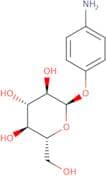
CAS:Kontrolliertes ProduktApplications 4-Aminophenyl α-D-Glucopyranoside is a glycoside derivative of 4-Aminophenol (A618920); a nephrotoxic metabolite of Acetaminophen (A161220) and Phenacetin (P294580) (1).
References (1) Watanabe, et al.: Drug Metab. Dispos., 38, 1532 (2010)Formel:C12H17NO6Farbe und Form:NeatMolekulargewicht:271.27