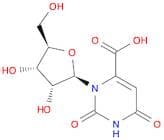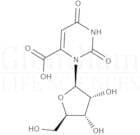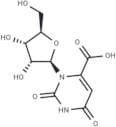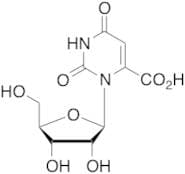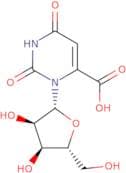
CAS 314-50-1
:Orotidin
- 1,2,3,6-Tetrahydro-2,6-dioxo-3-β-<span class="text-smallcaps">D</span>-ribofuranosyl-4-pyrimidinecarboxylic acid
- 3-Ribofuranosylorotic acid
- 4-Pyrimidinecarboxylic acid, 1,2,3,6-tetrahydro-2,6-dioxo-3-beta-D-ribofuranosyl-
- 4-Pyrimidinecarboxylic acid, 1,2,3,6-tetrahydro-2,6-dioxo-3-β-<span class="text-smallcaps">D</span>-ribofuranosyl-
- 6-Carboxyuridine
- Orotic acid riboside
- Orotidine
- 1,2,3,6-Tetrahydro-2,6-dioxo-3-β-D-ribofuranosyl-4-pyrimidinecarboxylic acid
- 4-Pyrimidinecarboxylic acid, 1,2,3,6-tetrahydro-2,6-dioxo-3-β-D-ribofuranosyl-
4-Pyrimidinecarboxylicacid, 1,2,3,6-tetrahydro-2,6-dioxo-3-b-D-ribofuranosyl-
CAS:Formel:C10H12N2O8Reinheit:90%Farbe und Form:SolidMolekulargewicht:288.2109Orotidine
CAS:Formel:C10H12N2O8Reinheit:≥ 90.0%Farbe und Form:Off-white to red powderMolekulargewicht:288.21Orotidine
CAS:Orotidine (Uridin-6-carboxylic acid) is a nucleoside found in bacteria, fungi, and plants. In humans, orotidine occurs as its 5'-phosphate (orotidylic acid).Formel:C10H12N2O8Reinheit:98%Farbe und Form:SolidMolekulargewicht:288.21Orotidine
CAS:Applications Orotidine is a metabolite of Orotic Acid (O691500); a compound used in the preparation of therapeutic agents for chronic obstructive pulmonary disease (COPD) treatment.
References Pausch, J., et al.: Verhandlungen der Deutschen Gesellschaft fuer Innere Medizin, 86, 805 (1980); Burgess, K., et al.: Rapid Commun. Mass. Sp., 25, 3447 (2011)Formel:C10H12N2O8Farbe und Form:NeatMolekulargewicht:288.21Orotidine
CAS:Orotidine is a decarboxylase inhibitor. It inhibits the enzyme that converts orotate to uridine and the enzyme that converts orotate to decarboxylase. Orotidine has been shown to inhibit the growth of opportunistic fungal organisms and may be useful in treating infections caused by these pathogens. Orotidine is an analytical method for measuring the activity of orotidase, which catalyzes conversion of orotate to uridine. The enzyme form of orotidase found in human erythrocytes is very sensitive to inhibition by picolinic acid, which is used as a substrate for this reaction.
Formel:C10H12N2O8Reinheit:Min. 95 Area-%Farbe und Form:White PowderMolekulargewicht:288.21 g/mol