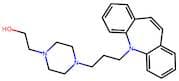
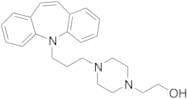
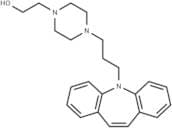
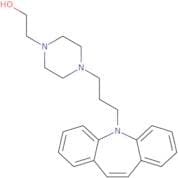
CAS 315-72-0
:Opipramol
- 1-Piperazineethanol, 4-(3-(5H-dibenz(b,f)azepin-5-yl)propyl)-
- 4-(3-(5H-Dibenz(b,f)azepin-5-yl)propyl)-1-piperazineethanol
- 5H-Dibenz(b,f)azepine, 5-(3-(4-(2-hydroxyethyl)-1-piperazinyl)propyl)-
- 5H-Dibenz[b,f]azepine, 1-piperazineethanol deriv.
- Brn 0627076
- Endison
- G 33040
- Gr 33040
- N-(3-(4-(2-Hydroxyethyl)piperazino)propyl)iminostilbene
- Nisidana
- Nsc 169867
- Opipramol G
- Opipramol [INN:BAN]
- Opipramolum
- Opipramolum [INN-Latin]
- Opramidol
- Unii-D23Zxo613C
- Opipramol
- 5-23-01-00475 (Beilstein Handbook Reference)
- 4-(3-(DIBENZ(B,F)AZEPIN-5-YL)PROPYL)-1-PIPERAZINEETHANOL
- Weitere Synonyme anzeigen
1-Piperazineethanol, 4-[3-(5H-dibenz[b,f]azepin-5-yl)propyl]-
CAS:Formel:C23H29N3OReinheit:98%Farbe und Form:SolidMolekulargewicht:363.4959Opipramol
CAS:Formel:C23H29N3OReinheit:≥ 98%Farbe und Form:White to yellow powder or crystalsMolekulargewicht:363.50Opipramol
CAS:Kontrolliertes ProduktApplications Antidepressant; antipsychotic.
Not a dangerous good if item is equal to or less than 1g/ml and there is less than 100g/ml in the package
References Maxwell, R.A., et al.: J. Pharm. Exper. Therap., 178, 158 (1970), Tait, A.C., et al.: J. Clin Pharmac., 2, 93 (1975), Rossi, G.V., et al.: Am. J. Pharm., 148, 37 (1976), Hubbard, J.W., et al.: J. Pharm. Sci., 67, 1571 (1978),Formel:C23H29N3OFarbe und Form:YellowMolekulargewicht:363.5Opipramol
CAS:Opipramol (Ensidon) is a compound with antidepressant activity, a sigma (σ) receptor agonist, and anxiolytic activity.Formel:C23H29N3OReinheit:99.84% - 99.98%Farbe und Form:SolidMolekulargewicht:363.5Opipramol
CAS:Kontrolliertes ProduktOpipramol is a tricyclic antidepressant drug that is used to treat bowel disease. It has been shown to have an effect on locomotor activity, dopamine levels, and ryanodine receptor. Opipramol binds to the rat liver microsomes and inhibits mitochondrial functions by inhibiting the synthesis of ATP. It also increases fat cell size by stimulating lipogenesis in fat cells, which may lead to weight gain. This drug also modulates biological samples such as serum or plasma. Opipramol has been shown to have anti-inflammatory effects in rats with chronic colitis, reducing symptoms such as pain and diarrhea.
Formel:C23H29N3OReinheit:Min. 95%Farbe und Form:PowderMolekulargewicht:363.5 g/molRef: 3D-FO26574
Ausgelaufenes produkt
![1-Piperazineethanol, 4-[3-(5H-dibenz[b,f]azepin-5-yl)propyl]-](/_next/image/?url=https%3A%2Fstatic.cymitquimica.com%2Fproducts%2FIN%2Fthumb%2FDA01CBWU.jpg&w=3840&q=75)