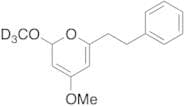
CAS 3155-51-9
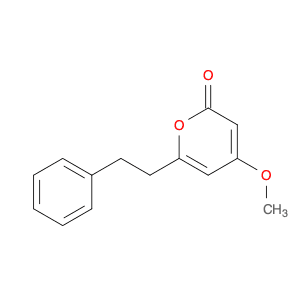
:5,6-Didehydro-7,8-dihydrokawain
Beschreibung:
5,6-Didehydro-7,8-dihydrokawain, identifiziert durch seine CAS-Nummer 3155-51-9, ist eine chemische Verbindung, die zur Klasse der Naturprodukte gehört, die als Chalcone bekannt sind. Sie stammt von Pflanzenarten der Gattung *Kawain*, die für ihre psychoaktiven Eigenschaften bekannt ist. Diese Verbindung weist eine einzigartige Struktur auf, die durch ein konjugiertes System von Doppelbindungen gekennzeichnet ist, was zu ihrer potenziellen biologischen Aktivität beiträgt. Sie zeigt Eigenschaften wie antioxidative und entzündungshemmende Effekte, die in der pharmakologischen Forschung Interesse geweckt haben. Die Verbindung wird typischerweise auf ihre Auswirkungen auf das zentrale Nervensystem untersucht und kann mit verschiedenen Neurotransmittersystemen interagieren. Darüber hinaus können ihre Löslichkeit und Stabilität je nach Umweltbedingungen variieren, was für ihre Anwendung sowohl in der Forschung als auch in potenziellen therapeutischen Kontexten wichtig ist. Wie bei vielen Naturprodukten sind weitere Studien erforderlich, um ihre Wirkmechanismen und potenziellen gesundheitlichen Vorteile vollständig zu erhellen.
Formel:C14H14O3
InChl:InChI=1/C14H14O3/c1-16-13-9-12(17-14(15)10-13)8-7-11-5-3-2-4-6-11/h2-6,9-10H,7-8H2,1H3
InChI Key:InChIKey=OVXOWIKMOIVICB-UHFFFAOYSA-N
SMILES:C(CC1=CC=CC=C1)C2=CC(OC)=CC(=O)O2
Synonyme:- 2,4-Heptadienoic acid, 5-hydroxy-3-methoxy-7-phenyl-, δ-lactone
- 2H-Pyran-2-one, 4-methoxy-6-(2-phenylethyl)-
- 2H-Pyran-2-one, 4-methoxy-6-phenethyl-
- 5,6-Dehydro-7,8-dihydrokavain
- 5,6-Didehydro-7,8-dihydrokawain
- Kawain, 5,6-dehydro-7,8-dihydro-
- 4-Methoxy-6-(2-phenylethyl)-2H-pyran-2-one
- 7,8-dihydro-5,6-dehydrokawain
Sortieren nach
Reinheit (%)
0
100
|
0
|
50
|
90
|
95
|
100
5 Produkte.
7,8-dihydro-5,6-dehydrokawain
CAS:Formel:C14H14O3Reinheit:98.0%Farbe und Form:SolidMolekulargewicht:230.25925,6-dehydro 7,8-dihydrokavain
CAS:LactoneFormel:C14H14O3Reinheit:≥ 95.0 % (HPLC)Farbe und Form:PowderMolekulargewicht:230.264-Methoxy-6-(2-phenylethyl)-2H-pyran-2-one
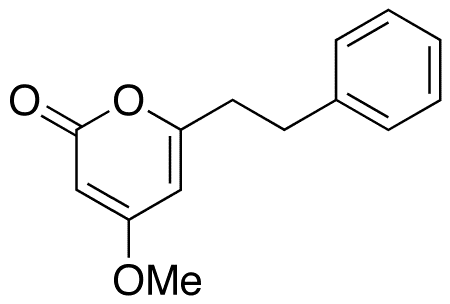
CAS:Kontrolliertes ProduktApplications 4-Methoxy-6-(2-phenylethyl)-2H-pyran-2-one is a Kawain (K145490) derivative that is known to exhibit antimalarial and antituberculosis activities. 4-Methoxy-6-(2-phenylethyl)-2H-pyran-2-one has been identified as a lead compound for the dual treatment of malaria and leishmaniasis.
References McCracken, S.T., et al.: Bioorg. Med. Chem., 20, 1482 (2012); Elzaawely, A.A.. et al.: Food. Chem., 103, 486 (2007); Xuan, T.D., et al.: J. Natural. Med., 62, 188 (2008);Formel:C14H14O3Farbe und Form:NeatMolekulargewicht:230.264-Methoxy-6-(2-phenylethyl)-2H-pyran-2-one
CAS:4-Methoxy-6-(2-phenylethyl)-2H-pyran-2-one is a phosphorothionate insecticide that has been used in biotechnology and horticulture. It is effective against termites, ants, and plant pathogenic fungi. The mechanism of action for this compound is not well understood, but it has been shown to have antifungal activity against different species of fungi. 4-Methoxy-6-(2-phenylethyl)-2H-pyran-2-one can be synthesized from 2,4,6,-triisopropylbenzenesulfonyl chloride with alpine plants such as alpinia or corticium. This compound also has a pleasant odor reminiscent of the aromatic ethers found in speciosa leaves. The chemical structure of 4-methoxy-6-(2 phenylethyl)-2H pyran 2 one can beFormel:C14H14O3Reinheit:Min. 95%Farbe und Form:PowderMolekulargewicht:230.26 g/mol4-Methoxy-6-(2-phenylethyl)-2H-pyran-2-one-d3
CAS:Kontrolliertes ProduktFormel:C15D3H15O3Farbe und Form:NeatMolekulargewicht:249.32