CAS 3158-71-2
:4-Cyclopropylanilin
Beschreibung:
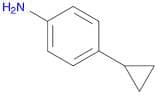
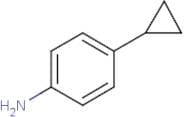
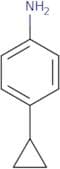
4-Cyclopropylanilin, mit der CAS-Nummer 3158-71-2, ist eine organische Verbindung, die durch eine Cyclopropylgruppe gekennzeichnet ist, die an der Para-Position einer Anilinstruktur angebracht ist. Diese Verbindung weist einen Benzolring auf, der an eine Aminogruppe (-NH2) und ein cyclopropylisches Substituenten gebunden ist, was einzigartige sterische und elektronische Eigenschaften einführt. Das Vorhandensein der Cyclopropylgruppe kann die Reaktivität und Stabilität der Verbindung beeinflussen und sie oft reaktiver machen als ihre nicht-cyclopropylischen Gegenstücke. 4-Cyclopropylanilin ist typischerweise eine farblose bis blassgelbe Flüssigkeit oder ein Feststoff, abhängig von Reinheit und Temperatur. Es ist in organischen Lösungsmitteln löslich, hat jedoch eine begrenzte Löslichkeit in Wasser aufgrund seiner hydrophoben Cyclopropylgruppe. Diese Verbindung ist in verschiedenen Bereichen von Interesse, einschließlich der medizinischen Chemie und der Materialwissenschaft, aufgrund ihrer potenziellen Anwendungen in der Arzneimittelentwicklung und als Baustein für komplexere organische Moleküle. Sicherheitsvorkehrungen sollten beim Umgang mit dieser Verbindung beachtet werden, da sie gesundheitliche Risiken darstellen kann, wenn sie eingenommen oder eingeatmet wird.
Formel:C9H11N
InChl:InChI=1/C9H11N/c10-9-5-3-8(4-6-9)7-1-2-7/h3-7H,1-2,10H2
SMILES:C1CC1c1ccc(cc1)N
Synonyme:- 4-Cyclopropylbenzenamine
- Benzenamine, 4-cyclopropyl-
- 4-Cyclopropylaniline
Sortieren nach
Reinheit (%)
0
100
|
0
|
50
|
90
|
95
|
100
4 Produkte.
4-Cyclopropylaniline
CAS:4-CyclopropylanilineFormel:C9H11NReinheit:≥95%Farbe und Form: clear. darkbrown liquidMolekulargewicht:133.19g/mol4-Cyclopropylaniline
CAS:4-Cyclopropylaniline is a terminal, mesogenic section with the cycloalkyl group. A liquid crystal is a phase of matter that displays an ordered arrangement of molecules and exhibits properties intermediate between those of liquids and solids. The molecules in a liquid crystal are typically rod- or disc-shaped, but can also be spherical. Liquid crystals have some degree of order at all times, but they may become more or less ordered over time. This can happen because the molecules are able to rotate freely within the liquid crystal's structure. Crystals are solid materials that have an orderly internal atomic structure. Crystals form when atoms or molecules attach to each other in a repeating pattern that extends in all three dimensions. Homologous compounds have similar molecular structures, which means they have similar chemical properties and react similarly with other compounds. The linkage between two adjacent carbon atoms is covalent bonding, while the linkage between two adjacent nitrogen atoms is called a single bond.Formel:C9H11NReinheit:Min. 95%Molekulargewicht:133.19 g/mol