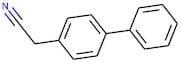
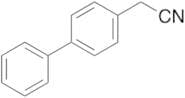
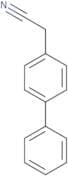
CAS 31603-77-7
:Biphenylacetonitril
- 4-Biphenylacetonitrile
- 4-Phenylbenzyl cyanide
- Biphenyl-4-Ylacetonitrile
4-Biphenylacetonitrile
CAS:Formel:C14H11NReinheit:>95.0%(GC)Farbe und Form:White to Orange to Green powder to crystalMolekulargewicht:193.254-Biphenylacetonitrile, 97%
CAS:This Thermo Scientific Chemicals brand product was originally part of the Alfa Aesar product portfolio. Some documentation and label information may refer to the legacy brand. The original Alfa Aesar product / item code or SKU reference has not changed as a part of the brand transition to Thermo SciFormel:C14H11NReinheit:97%Farbe und Form:White to pale yellow, PowderMolekulargewicht:193.252-([1,1'-biphenyl]-4-yl)acetonitrile
CAS:Formel:C14H11NReinheit:96%Farbe und Form:SolidMolekulargewicht:193.2438(Biphenyl-4-yl)acetonitrile
CAS:(Biphenyl-4-yl)acetonitrileFormel:C14H11NReinheit:96%Farbe und Form: off white. lumpy powderMolekulargewicht:193.24g/molp-Biphenylacetonitrile
CAS:Kontrolliertes ProduktApplications 4-Biphenylacetonitrile is a useful synthetic intermediate. It was used to study the adsorption orientation of the biphenyl derivatives on the Au colloidal surfaces with α-cyclodextrins. 4-Biphenylacetonitrile on condensation reaction with ethyl phenyl propiolate yields biphenyl derivatives of acetylenic β-ketocyanide.
References Lee, J., et al.: Bull. Korean. Chem. Soc., 30, 1637 (2009); Al-Jallo, H., et al.: J. Chem. Eng. Data, 17, 513, (1972)Formel:C14H11NFarbe und Form:NeatMolekulargewicht:193.244-Biphenylacetonitrile
CAS:Biphenylacetonitrile is an organic compound that belongs to the group of reactive functional groups and is used as a reagent in organic synthesis. It has been shown to inhibit the growth of cancer cells, likely due to its ability to react with sulfamates. Biphenylacetonitrile inhibits the production of the inflammatory mediator nitric oxide by reacting with trifluoroacetic acid, which may be useful for treating inflammatory diseases such as endometriosis. This drug also has an inhibitory effect on fatty acid metabolism and can thus be used for treating diabetes patients.
Formel:C14H11NReinheit:Min. 95%Molekulargewicht:193.24 g/mol
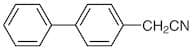

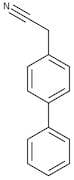

![2-([1,1'-biphenyl]-4-yl)acetonitrile](/_next/image/?url=https%3A%2Fstatic.cymitquimica.com%2Fproducts%2FIN%2Fthumb%2FDA003KU3.jpg&w=3840&q=75)