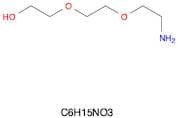
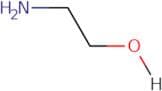
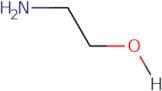
CAS 32130-27-1
:Polyethylenglykol-2-aminoethyl-ether
- α-(2-Aminoethyl)-ω-hydroxypoly(oxyethylene)
- α-(Aminoethyl)-ω-hydroxy-poly(oxy-1,2-ethanediyl)
- α-Hydro-ω-(2-aminoethoxy)poly(oxy-1,2-ethanediyl)
- Polyethylene glycol monoethanolamine ether
- Poly(oxy-1,2-ethanediyl), α-(2-aminoethyl)-ω-hydroxy-
m-PEG24-amine
CAS:m-PEG24-amine is a PEG derivative containing an amino group. PEG Linkers may be useful in the development of antibody-drug conjugates and drug delivery methods.Formel:C49H101NO24Farbe und Form:SolidMolekulargewicht:1088.33O-(2-Aminoethyl)Polyethylene Glycol
CAS:O-(2-Aminoethyl)Polyethylene GlycolReinheit:95%,average M.W.2000O-(2-Aminoethyl)polyethylene glycol 3,000
CAS:O-(2-Aminoethyl)polyethylene glycol 3,000 (PEG3K) is a cationic surfactant that has antibiotic-resistant properties. PEG3K can be used to treat cancers and bacterial infections. It is a superparamagnetic iron particles that can be used to target specific cells because of its magnetic properties. This compound is also an acylation reaction with an amine group and an ester bond.Formel:(C2H4O)nC2H7NOReinheit:Min. 95%Farbe und Form:White PowderCBZ-N-Amido-dPEG®3-Amine
CAS:CBZ-N-Amido-dPEG®3-Amine is a PEG compound with two different functional groups (also known as heterobifunctional). Unlike homobifunctional PEG compounds (same functional group on both ends), this type of compounds are more versatile as have two different anchor points. CBZ-N-Amido-dPEG®3-Amine is used as a linker and spacer to add a PEG moiety, via pegylation (a bioconjugation technique) to proteins, peptides, oligonucleotides, small molecules and nanoparticles.Formel:C25H53NO12Reinheit:Min. 95%Molekulargewicht:559.69 g/molm-dPEG®12-Amine
CAS:m-dPEG®12-Amine is a PEG compound with two different functional groups (also known as heterobifunctional). Unlike homobifunctional PEG compounds (same functional group on both ends), this type of compounds are more versatile as have two different anchor points. m-dPEG®12-Amine is used as a linker and spacer to add a PEG moiety, via pegylation (a bioconjugation technique) to proteins, peptides, oligonucleotides, small molecules and nanoparticles.
Reinheit:Min. 95%Molekulargewicht:559.69 g/molm-dPEG®48-Amine
CAS:m-dPEG®48-Amine is a PEG compound with two different functional groups (also known as heterobifunctional). Unlike homobifunctional PEG compounds (same functional group on both ends), this type of compounds are more versatile as have two different anchor points. m-dPEG®48-Amine is used as a linker and spacer to add a PEG moiety, via pegylation (a bioconjugation technique) to proteins, peptides, oligonucleotides, small molecules and nanoparticles.Formel:C97H197NO48Reinheit:(%) Min. 90%Molekulargewicht:2,145.58 g/molm-dPEG®15-Amine
CAS:m-dPEG®15-Amine is a PEG compound with two different functional groups (also known as heterobifunctional). Unlike homobifunctional PEG compounds (same functional group on both ends), this type of compounds are more versatile as have two different anchor points. m-dPEG®15-Amine is used as a linker and spacer to add a PEG moiety, via pegylation (a bioconjugation technique) to proteins, peptides, oligonucleotides, small molecules and nanoparticles.Formel:C59H109NO28Reinheit:Min. 95%Molekulargewicht:1,280.49 g/molm-dPEG®24-Amine
CAS:m-dPEG®24-Amine is a PEG compound with two different functional groups (also known as heterobifunctional). Unlike homobifunctional PEG compounds (same functional group on both ends), this type of compounds are more versatile as have two different anchor points. m-dPEG®24-Amine is used as a linker and spacer to add a PEG moiety, via pegylation (a bioconjugation technique) to proteins, peptides, oligonucleotides, small molecules and nanoparticles.Reinheit:Min. 95%Molekulargewicht:1,088.32 g/molm-dPEG®24-TFP Ester
CAS:m-dPEG®24-TFP Ester is a PEG compound with two different functional groups (also known as heterobifunctional). Unlike homobifunctional PEG compounds (same functional group on both ends), this type of compounds are more versatile as have two different anchor points. m-dPEG®24-TFP Ester is used as a linker and spacer to add a PEG moiety, via pegylation (a bioconjugation technique) to proteins, peptides, oligonucleotides, small molecules and nanoparticles.
Formel:C49H101NO24Reinheit:Min. 95%Molekulargewicht:1,088.32 g/molm-dPEG®36-Amine
CAS:m-dPEG®36-Amine is a PEG compound with two different functional groups (also known as heterobifunctional). Unlike homobifunctional PEG compounds (same functional group on both ends), this type of compounds are more versatile as have two different anchor points. m-dPEG®36-Amine is used as a linker and spacer to add a PEG moiety, via pegylation (a bioconjugation technique) to proteins, peptides, oligonucleotides, small molecules and nanoparticles.
Formel:C73H149NO36Reinheit:Min. 95%Molekulargewicht:1,616.95 g/mol