![[1,1′-Biphenyl]-4-carboxaldehyde](/_next/image/?url=https%3A%2Fstatic.cymitquimica.com%2Fcas-image%2Fthumb-webp%2F232415-11-biphenyl-4-carboxaldehyde.webp&w=3840&q=75)
CAS 3218-36-8
:[1,1'-Biphenyl]-4-carbaldehyd
Beschreibung:
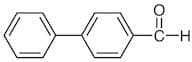
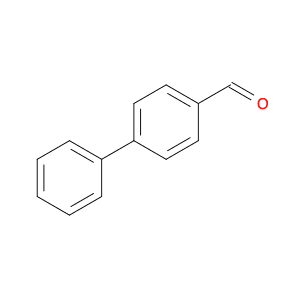
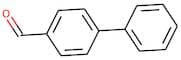
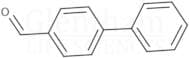
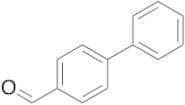
[1,1'-Biphenyl]-4-carbaldehyd, auch bekannt als 4-Biphenylcarboxaldehyd, ist eine organische Verbindung, die durch das Vorhandensein einer Biphenylstruktur mit einer Aldehydfunktionalität in der Para-Position gekennzeichnet ist. Es hat eine molekulare Formel, die sein Biphenylgerüst und die Aldehydgruppe widerspiegelt, was zu seiner Reaktivität und potenziellen Anwendungen in der organischen Synthese beiträgt. Diese Verbindung erscheint typischerweise als farblose bis blassgelbe Flüssigkeit oder Feststoff, abhängig von Temperatur und Reinheit. Sie ist bekannt für ihre aromatischen Eigenschaften, die ihr Verhalten in chemischen Reaktionen, insbesondere in der elektrophilen aromatischen Substitution, beeinflussen können. Die Aldehydgruppe macht sie zu einem vielseitigen Zwischenprodukt in der Synthese verschiedener organischer Verbindungen, einschließlich pharmazeutischer Produkte und Agrochemikalien. Darüber hinaus kann [1,1'-Biphenyl]-4-carbaldehyd eine moderate Löslichkeit in organischen Lösungsmitteln aufweisen, während ihre Reaktivität in Kondensationsreaktionen und als Baustein in komplexeren molekularen Architekturen genutzt werden kann. Sicherheitsvorkehrungen sollten beim Umgang mit dieser Verbindung beachtet werden, wie bei vielen organischen Chemikalien, aufgrund potenzieller Gesundheitsrisiken.
Formel:C13H10O
InChl:InChI=1S/C13H10O/c14-10-11-6-8-13(9-7-11)12-4-2-1-3-5-12/h1-10H
InChI Key:InChIKey=ISDBWOPVZKNQDW-UHFFFAOYSA-N
SMILES:C(=O)C1=CC=C(C=C1)C2=CC=CC=C2
Synonyme:- 4-Biphenylaldehyde
- 4-Biphenylcarboxaldehyde
- 4-Biphenylylcarboxaldehyde
- 4-Formyl-1,1'-biphenyl
- 4-Formylbiphenyl
- 4-Phenyl-Benzaldehyde
- 4-Phenylbenzaldehyde
- Benzaldehyde, p-phenyl-
- Biphenyl-4-carbaldehyde
- Nsc 46066
- P-Fenilbenzaldehido
- P-Phenylbenzaldehyde
- [1,1′-Biphenyl]-4-carbaldehyde
- p-Biphenylaldehyde
- p-Biphenylcarboxaldehyde
- p-Biphenylylaldehyde
- p-Phenylbenzaldehyd
- P-Diphenylcarboxaldehyde
- P-Diphenylaldehyde
- 4-Biphenylcarboxyaldehyde
- [1,1′-Biphenyl]-4-carboxaldehyde
- Diphenyl-4-carboxaldehyde
- (1,1'-Biphenyl)-4-carboxaldehyde
- Weitere Synonyme anzeigen
Sortieren nach
Reinheit (%)
0
100
|
0
|
50
|
90
|
95
|
100
11 Produkte.
Biphenyl-4-carboxaldehyde
CAS:Formel:C13H10OReinheit:>95.0%(GC)Farbe und Form:White to Orange to Green powder to crystalMolekulargewicht:182.22Biphenyl-4-carboxaldehyde, 98+%
CAS:This Thermo Scientific Chemicals brand product was originally part of the Alfa Aesar product portfolio. Some documentation and label information may refer to the legacy brand. The original Alfa Aesar product / item code or SKU reference has not changed as a part of the brand transition to Thermo SciFormel:C13H10OReinheit:98+%Farbe und Form:Crystals or powder or crystalline powder or lumps or fused solid, White to cream to yellow to pale orangeMolekulargewicht:182.22Biphenyl-4-carboxaldehyde
CAS:Biphenyl-4-carboxaldehydeFormel:C13H10OReinheit:98%Farbe und Form: white to off white crystalsMolekulargewicht:182.22g/mol4-Biphenylcarboxaldehyde
CAS:Formel:C13H10OReinheit:≥ 98.0%Farbe und Form:White to yellow crystalline powderMolekulargewicht:182.224-Biphenylcarboxaldehyde
CAS:4-Biphenylcarboxaldehyde is a chemical compound that belongs to the group of hydrocarbons. It is a colorless liquid with an unpleasant odor, soluble in ether and benzene, and has a boiling point of 210 °C. 4-Biphenylcarboxaldehyde can be used as a raw material for the production of pharmaceuticals and agrochemicals. The molecular structure of this compound is unsymmetrical due to its biphenyl backbone and two carbonyl groups. Hydrochloric acid reacts with 4-biphenylcarboxaldehyde to form 2-bromoethylbenzene and hydrogen gas:Formel:C13H10OReinheit:Min. 95%Farbe und Form:White PowderMolekulargewicht:182.22 g/molBiphenyl-4-carboxaldehyde
CAS:Formel:C13H10OReinheit:98%Farbe und Form:Solid, CrystallineMolekulargewicht:182.2224-Biphenylylcarboxaldehyde
CAS:Kontrolliertes ProduktApplications 4-Biphenylylcarboxaldehyde is used in biological studies to evaluate the effects of common chemical substituents on ligand potency.
References Hajduck, P. J., et al.: J. Med. Chem., 51, 553 (2008)Formel:C13H10OFarbe und Form:NeatMolekulargewicht:182.22