CAS 32315-10-9
:Bis(trichlormethylcarbonat)
Beschreibung:
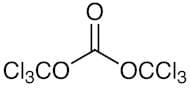
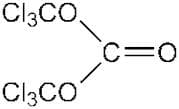
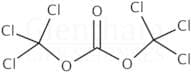
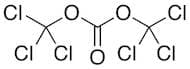
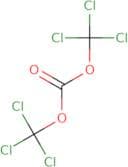
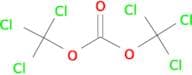
Bis(trichlormethylcarbonat), mit der CAS-Nummer 32315-10-9, ist eine organische Verbindung, die durch ihre Struktur gekennzeichnet ist, die zwei Trichlormethylgruppen enthält, die an eine Carbonatgruppe gebunden sind. Diese Verbindung ist typischerweise eine farblose bis blassgelbe Flüssigkeit und ist bekannt für ihre starke Reaktivität, insbesondere als chlorierendes Mittel. Sie hat einen relativ niedrigen Siedepunkt und ist in organischen Lösungsmitteln löslich, was sie in verschiedenen chemischen Reaktionen nützlich macht. Die Anwesenheit mehrerer Chloratome trägt zu ihrer hohen Elektronegativität und ihrem Potenzial zur Bildung stabiler Komplexe mit anderen Molekülen bei. Aufgrund ihrer Reaktivität ist es wichtig, diese Verbindung mit Vorsicht zu behandeln, da sie bei der Zersetzung giftige Gase freisetzen kann. Darüber hinaus wird sie in der organischen Synthese verwendet und kann als Zwischenprodukt bei der Herstellung anderer chemischer Substanzen dienen. Sicherheitsvorkehrungen sind beim Arbeiten mit dieser Verbindung unerlässlich, angesichts ihrer gefährlichen Natur und potenziellen Umweltauswirkungen.
Formel:C3O3Cl6
InChl:InChI=1/C3Cl6O3/c4-2(5,6)11-1(10)12-3(7,8)9
InChI Key:InChIKey=UCPYLLCMEDAXFR-UHFFFAOYSA-N
SMILES:C(=O)(OC(Cl)(Cl)Cl)OC(Cl)(Cl)Cl
Synonyme:- Bis(trichlormethyl)carbonat
- Bis-(Trichloromethyl)-Carbonat
- Carbonate De Bis(Trichloromethyle)
- Carbonato De Bis(Triclorometilo)
- Carbonic Acid Bistrichlor Methyl Ester
- Carbonic acid, bis(trichloromethyl) ester
- Methanol, 1,1,1-trichloro-, 1,1'-carbonate
- Methanol, Trichloro-, Carbonate (2:1)
- Trichloromethanol carbonate (2:1)
- Triphosgen
- Triphosgene
- btc
- Weitere Synonyme anzeigen
Sortieren nach
Reinheit (%)
0
100
|
0
|
50
|
90
|
95
|
100
7 Produkte.
Triphosgene
CAS:Formel:C3Cl6O3Reinheit:>98.0%(T)Farbe und Form:White to Yellow powder to lumpMolekulargewicht:296.73Triphosgene, 98%
CAS:Triphosgene is used as a carbonylating agent for aza-peptide synthesis. It reacts with several alfa-amino acids to give the corresponding N-carboxyanhydrides. It is involved in the preparation of the esterification coupling reagent, di-2-thienyl carbonate from 2(5H)-thiophenone. Further, it is usedFormel:C3Cl6O3Reinheit:98%Farbe und Form:Colorless to white to pale cream to pale yellow, Crystals or powder or crystalline powder or lumps or fused solidMolekulargewicht:296.73Triphosgene
CAS:Formel:C3Cl6O3Reinheit:≥ 98.0%Farbe und Form:White to off-white solid or crystalsMolekulargewicht:296.75Triphosgene (Technical grade)
CAS:Kontrolliertes ProduktApplications An efficient carbonylating agent for liquid and solid-phase aza-peptide synthesis.
Not a dangerous good if item is equal to or less than 1g/ml and there is less than 100g/ml in the package
References Ferrari, B., et al.: Bioorg. Med. Chem. Lett., 4, 45 (1994),Formel:C3Cl6O3Farbe und Form:NeatMolekulargewicht:296.75Triphosgene
CAS:Triphosgene, also known as bis(trichloromethyl) carbonate (BTC), is a safer version of the chemical phosgene (Cotarca, 2017). While this is a gas, triphosgene is a solid at room temperature and has a decomposition temperature higher than 200 °C. In organic synthesis, triphosgene is used to produce a considerable number of products, such as: ureas, isocyanates, carboxylic acid anhydrides, alkylchorides, and is a carbonyl addition for some chemical reactions. Due to the versatility of triphosgene as a chemical reagent, it is widely used in polymer chemistry to produce resins, adhesives, elastomers, and thermoplastics. Triphosgene has many other applications including uses in agrochemicals to produce pesticides and in pharmaceuticals to synthesize APIs.Formel:C3Cl6O3Reinheit:(Titration) Min. 99%Farbe und Form:White Off-White PowderMolekulargewicht:296.75 g/molTriphosgene
CAS:M03560 - Triphosgene
Formel:C3Cl6O3Reinheit:>99%Farbe und Form:SolidMolekulargewicht:296.73