CAS 3237-50-1
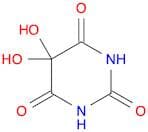
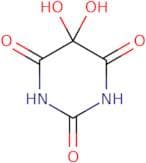
:5,5-Dihydroxy-2,4,6(1H,3H,5H)-pyrimidintrion
Beschreibung:
5,5-Dihydroxy-2,4,6(1H,3H,5H)-pyrimidintrion, auch bekannt als Uracil-5,5-diol, ist ein Pyrimidinderivat, das durch das Vorhandensein von zwei Hydroxylgruppen an der Position 5 und einer Trionstruktur gekennzeichnet ist. Diese Verbindung weist einen sechsgliedrigen aromatischen Ring auf, der Stickstoffatome enthält, was zu ihrer Stabilität und Reaktivität beiträgt. Sie ist typischerweise ein weißes bis off-white kristallines Feststoff, der in Wasser löslich ist, da die Hydroxylgruppen Wasserstoffbrücken bilden können. Die Verbindung zeigt Eigenschaften, die für Pyrimidine typisch sind, einschließlich potenzieller biologischer Aktivität, da sie mit Nukleinsäuren und Enzymen interagieren kann. Ihre Struktur ermöglicht tautomerische Formen, die ihre Reaktivität und Interaktionen in biochemischen Wegen beeinflussen können. 5,5-Dihydroxy-2,4,6(1H,3H,5H)-pyrimidintrion ist in verschiedenen Bereichen von Interesse, einschließlich der medizinischen Chemie und der Biochemie, aufgrund ihrer potenziellen Anwendungen in der Arzneimittelentwicklung und als biochemischer Sonden.
Formel:C4H4N2O5
InChl:InChI=1S/C4H4N2O5/c7-1-4(10,11)2(8)6-3(9)5-1/h10-11H,(H2,5,6,7,8,9)
InChI Key:InChIKey=ZIIHZVKHFWOENY-UHFFFAOYSA-N
SMILES:OC1(O)C(=O)NC(=O)NC1=O
Synonyme:- 2,4,6(1H,3H,5H)-Pyrimidinetrione, 5,5-dihydroxy-
- 5-24-09-00382 (Beilstein Handbook Reference)
- 5,5-Dihydroxy-2,4,6(1H,3H,5H)-pyrimidinetrione
- 2,4,5,6(1H,3H)-Pyrimidinetetrone, monohydrate
- NSC 221304
- 2,4,5,6(1H,3H)-Pyrimidinetetrone hydrate
- Alloxan hydrate
- 5,5-Dihydroxybarbituric acid
- 2,4,6(1H,3H,5H)-Pyrimidinetrione, 5,5-dihydroxy-
- 5,5-dihydroxypyrimidine-2,4,6(1H,3H,5H)-trione
- BRN 0155548
- Alloxan monohydrate
- Alloxan hydrate
- 2,4,6(1H,3H,5H)-Pyrimidinetrione, 5,5-dihydroxy- (9CI)
- 5,5-Dihydroxyperhydropyrimidinetrione
- Alloxan monohydrate
- CCRIS 5957
- Barbituric acid, 5,5-dihydroxy-
- Weitere Synonyme anzeigen
Sortieren nach
Reinheit (%)
0
100
|
0
|
50
|
90
|
95
|
100
4 Produkte.
Alloxan monohydrate, 98%
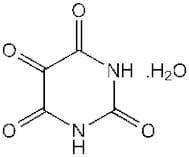
CAS:Cytotoxic compound that causes oxidative base damage to nuclear DNAAlloxan monohydrate is used as a precursor to prepare purple dye murexide. It is also used in research models to induce diabetes and destroy beta cells. Further, it is a strong oxidizing agent and it forms a hemiacetal with its reduc
Formel:C4H2N2O4•H2OReinheit:98%Farbe und Form:White to cream to yellow to brown to black, Crystals or powder or crystalline powderMolekulargewicht:160.09 (142.07anhy)5,5-Dihydroxypyrimidine-2,4,6(1H,3H,5H)-trione
CAS:Formel:C4H4N2O5Farbe und Form:SolidMolekulargewicht:160.0850Alloxan hydrate
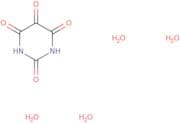
CAS:A pyrimidine derivative, widely used for the induction of diabetes in experimental animals. It preferentially accumulates in pancreatic β cells in Langerhans islets via glucose transporter GLUT2. In the presence of intracellular thiols such as glutathione, it gets involved in a cyclic redox reaction with its reduction product, dialuric acid. This triggers the production of toxic levels of reactive oxygen species (ROS) and directs the cells in necrosis. Alloxan also inhibits glucokinase, which regulates glucose-induced insulin secretion.Formel:C4H2N2O4•xH2OReinheit:Min. 95%Molekulargewicht:142.07 g/mol5,5-Dihydroxypyrimidine-2,4,6(1H,3H,5H)-trione
CAS:Kontrolliertes Produkt5,5-Dihydroxypyrimidine-2,4,6(1H,3H,5H)-trione is a chemical compound that is found in animals. It is an intermediate in the biosynthesis of pyrimidines. This molecule has been shown to have hypoglycemic effects when administered orally to diabetic patients. 5,5-Dihydroxypyrimidine-2,4,6(1H,3H,5H)-trione can be metabolized by nitro and alkoxy radicals to form reactive oxygen species that are cytotoxic. This chemical also has insulin-like growth factor activity and can stimulate the production of density lipoprotein (LDL).Formel:C4H4N2O5Reinheit:Min. 95%Molekulargewicht:160.09 g/mol