


CAS 33155-90-7
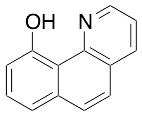
:Hydroxybenzochinolin
Beschreibung:
Hydroxybenzochinolin, mit der CAS-Nummer 33155-90-7, ist eine chemische Verbindung, die zur Klasse der heterocyclischen organischen Verbindungen gehört. Es weist eine Chinolinstruktur auf, die eine bicyclische Verbindung ist, die aus einem Benzolring besteht, der mit einem Pyridinring verschmolzen ist. Das Vorhandensein von Hydroxyl- (-OH) und Carbonyl- (C=O) funktionellen Gruppen trägt zu seiner Reaktivität und potenziellen Anwendungen bei. Hydroxybenzochinolin ist bekannt für seine Rolle in verschiedenen chemischen Reaktionen, einschließlich als Ligand in der Koordinationschemie und als Vorläufer in der Synthese anderer organischer Verbindungen. Es zeigt Eigenschaften wie Fluoreszenz und kann biologische Aktivität aufweisen, was es in der medizinischen Chemie und Materialwissenschaft von Interesse macht. Die Verbindung wird typischerweise durch ihre Löslichkeit in organischen Lösungsmitteln und ihre Stabilität unter Standardlaborbedingungen charakterisiert. Sicherheitsdaten sollten für den Umgang und die Lagerung konsultiert werden, wie bei jeder chemischen Substanz, um sicherzustellen, dass die richtigen Vorsichtsmaßnahmen getroffen werden.
Formel:C13H9NO
InChl:InChI=1/C13H9NO/c15-11-5-1-3-9-6-7-10-4-2-8-14-13(10)12(9)11/h1-8,15H
SMILES:c1cc2ccc3cccnc3c2c(c1)O
Synonyme:- 10-Hydroxybenzo[h]quinoline
- Benzo[H]Quinolin-10-Ol
Sortieren nach
Reinheit (%)
0
100
|
0
|
50
|
90
|
95
|
100
6 Produkte.
10-Hydroxybenzo[h]quinoline
CAS:Formel:C13H9NOReinheit:>98.0%(T)(HPLC)Farbe und Form:Light yellow to Amber to Dark green powder to crystalMolekulargewicht:195.22Benzo[h]quinolin-10-ol
CAS:Reinheit:95.0%Farbe und Form:Solid, Crystalline PowderMolekulargewicht:195.22099304199225-Hydroxy-4-azaphenanthrene
CAS:Kontrolliertes ProduktApplications 5-Hydroxy-4-azaphenanthrene is used to detect boronic acids in reactions and boron containing compounds on solid support. 5-Hydroxy-4-azaphenanthrene is also used as a proton transfer-fluoresence probe to be applied to human serum albumin and beaver apomyoglobin.
References Aronoff, M.R., et. al.: Org. Lett., 15, 5382 (2013); Sytnik, A., Kasha, M.: P. Natl. Acad. Sci. USA, 91, 8627 (1994)Formel:C13H9NOFarbe und Form:NeatMolekulargewicht:195.2210-Hydroxy-benzo[H]Quinoline
CAS:10-Hydroxy-benzo[H]quinoline is a fluorescence probe that can be used to detect the presence of human serum. It has been shown to have a high fluorescence intensity and a long lifetime, making it an ideal molecule for use as a fluorescent probe. The light emission from 10-hydroxy-benzo[H]quinoline is due to intramolecular hydrogen bonding and intermolecular hydrogen bonding between the carbonyl group and the phenyl ring. This bond is formed through proton transfer from the oxygen atom in the carbonyl group to the nitrogen atom in the phenyl ring. The quinoline derivatives are synthesized by reacting 2,4-dichloroquinoline with benzaldehyde or acetaldehyde in methanol at room temperature. The reaction mechanism for this synthesis involves the elimination of water, which generates benzoic acid and acetone.Reinheit:Min. 95%
![10-Hydroxybenzo[h]quinoline](/_next/image/?url=https%3A%2Fstatic.cymitquimica.com%2Fproducts%2F3B%2Fthumb%2FH0738.jpg&w=3840&q=75)

![Benzo[h]quinolin-10-ol](/_next/image/?url=https%3A%2Fstatic.cymitquimica.com%2Fproducts%2FIN%2Fthumb%2FDA0032NU.jpg&w=3840&q=75)

![10-Hydroxybenzo[h]quinoline](/_next/image/?url=https%3A%2Fstatic.cymitquimica.com%2Fproducts%2F54%2Fthumb%2FOR315046.jpg&w=3840&q=75)

![Benzo[h]quinolin-10-ol](/_next/image/?url=https%3A%2Fstatic.cymitquimica.com%2Fproducts%2F10%2Fthumb%2FF236534.jpg&w=3840&q=75)


![10-Hydroxy-benzo[H]Quinoline](/_next/image/?url=https%3A%2Fstatic.cymitquimica.com%2Fproducts%2F3D%2Fthumb%2FFH40574.jpg&w=3840&q=75)
