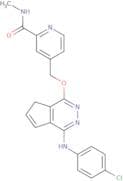
CAS 332012-40-5
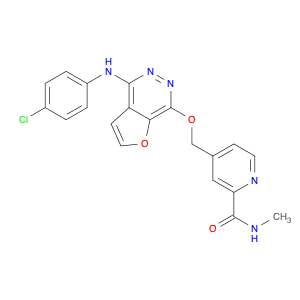
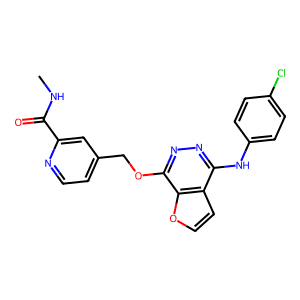
:Telatinib
- 2-Pyridinecarboxamide,4-[[[4-[(4-chlorophenyl)amino]furo[2,3-d]pyridazin-7-yl]oxy]methyl]-N-methyl-
- 4-[[[4-[(4-Chlorophenyl)amino]furo[2,3-d]pyridazin-7-yl]oxy]methyl]-N-methyl-2-pyridinecarboxamide
- Bay 57-9352
- Bay57-9352
- Telatinib
- 4-(((4-((4-Chlorophenyl)amino)furo[2,3-d]pyridazin-7-yl)oxy)methyl)-N-methylpicolinamide
- 4-[[[4-[(4-Chlorophenyl)amino]furo[2,3-d]pyridazin-7-yl]oxy]methyl]-N-methyl-2-pyridinecarboxamide Telatinib(BAY57-9352)
- Unii-18p7197Q7j
- Telatinib USP/EP/BP
- CS-361
- 4-((4-(4-chlorophenylamino)furo[2,3-d]pyridazin-7-yloxy)methyl)-N-methylpicolinamide
- Telatinib(BAY 57-9352)
- Telatnib
- 4-[[4-(4-Chloroanilino)furo[2,3-d]pyridazin-7-yl]oxymethyl]-N-methyl-pyridine-2-carboxamide
- Weitere Synonyme anzeigen
Telatinib
CAS:Telatinib (Bay 57-9352) inhibits VEGFR2/3, c-Kit, PDGFRα with IC50s: 6 nM, 4 nM, 1 nM, 15 nM.Formel:C20H16ClN5O3Reinheit:97.61% - 99.81%Farbe und Form:SolidMolekulargewicht:409.83Telatinib
CAS:Kontrolliertes ProduktApplications Telatinib small-molecule inhibitor of vascular endothelial growth factor receptors 2 and 3 (VEGFR-2/-3) and platelet-derived growth factor receptor β tyrosine kinases. Telatinib is used therapeutically in patients with advanced solid tumors.
References Strumberg, D. et al.: Br. J. Cancer, 99, 1579 (2008); Steeghs, N. et al.: Invest. New Drugs, 29, 137 (2011); Mross, K. et al.: Vasc. Cell, 3, 16 (2011);Formel:C20H16ClN5O3Farbe und Form:NeatMolekulargewicht:409.826Telatinib
CAS:Telatinib is a tyrosine kinase inhibitor that belongs to the group of cancer drugs. It is an orally available, small-molecule drug that inhibits the activity of receptor tyrosine kinases (RTKs). Telatinib has been shown to inhibit angiogenesis and to reduce tumour size and volume in solid tumours. In addition, telatinib inhibits the production of cytokines and other pro-inflammatory factors such as interleukin-6, IL-8, vascular endothelial growth factor, and glycoprotein 130. Telatinib also binds to ABCG2 transporter proteins and prevents them from absorbing drugs in the gastrointestinal tract. Telatinib has been tested in humans for indications such as renal cell carcinoma, cervical cancer, skin cancer, and other solid tumours.
Formel:C20H16ClN5O3Reinheit:Min. 95%Molekulargewicht:409.83 g/mol