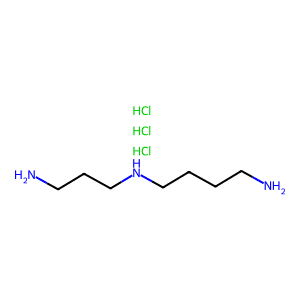
CAS 334-50-9
:Spermidin-trihydrochlorid
Beschreibung:
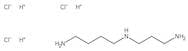
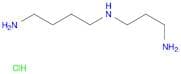
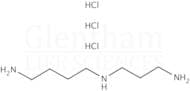
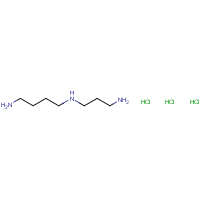
Spermidin-trihydrochlorid ist eine Polyaminverbindung, die eine entscheidende Rolle in zellulären Prozessen spielt, einschließlich Zellwachstum, Proliferation und Differenzierung. Es ist ein Derivat von Spermidin, das natürlich in allen lebenden Zellen vorkommt und an verschiedenen biologischen Funktionen beteiligt ist, wie der Stabilisierung von DNA- und RNA-Strukturen. Die Trihydrochlorid-Form zeigt an, dass die Verbindung mit drei Hydrochlorid-Ionen assoziiert ist, was ihre Löslichkeit in Wasser erhöht und sie für verschiedene biochemische Anwendungen geeignet macht. Spermidin-trihydrochlorid wird häufig in Forschungseinrichtungen verwendet, insbesondere in Studien, die sich mit Alterung, Autophagie und Zellstoffwechsel befassen. Zu seinen Eigenschaften gehört, dass es sich um ein farbloses bis weißes kristallines Feststoff handelt, mit einem relativ hohen Schmelzpunkt. Die Verbindung wird typischerweise mit Vorsicht behandelt, aufgrund ihrer biologischen Aktivität und potenziellen Auswirkungen auf zelluläre Prozesse. Wie viele Polyamine kann es eine Reihe von physiologischen Effekten zeigen, einschließlich der Förderung des Zellwachstums und der Beeinflussung der Genexpression.
Formel:C7H19N3·3ClH
InChl:InChI=1S/C7H19N3.3ClH/c8-4-1-2-6-10-7-3-5-9;;;/h10H,1-9H2;3*1H
InChI Key:InChIKey=LCNBIHVSOPXFMR-UHFFFAOYSA-N
SMILES:C(NCCCN)CCCN.Cl
Synonyme:- 1,4-Butanediamine, N-(3-aminopropyl)-, trihydrochloride
- 1,4-Butanediamine, N<sup>1</sup>-(3-aminopropyl)-, hydrochloride (1:3)
- 1,4-Butanediamine, N~1~-(3-aminopropyl)-, hydrochloride (1:3)
- N-(3-aminopropyl)-1,4-butanediamine, trihydrochloride
- Spermidine hydrochloride
- Spermidine trihydrochloride
- N-(3-Aminopropyl)butane-1,4-diamine trihydrochloride
- 1,4-Butanediamine, N1-(3-aminopropyl)-, hydrochloride (1:3)
Sortieren nach
Reinheit (%)
0
100
|
0
|
50
|
90
|
95
|
100
12 Produkte.
Spermidine trihydrochloride, 99+%
CAS:Binds and precipitates DNA; may be used for purification of DNA binding proteinsFormel:C7H22Cl3N3Reinheit:99+%Farbe und Form:White, Crystals or crystalline powderMolekulargewicht:254.62Spermidine trihydrochloride
CAS:Formel:C7H22Cl3N3Reinheit:%Farbe und Form:SolidMolekulargewicht:254.6287Spermidine trihydrochloride
CAS:Formel:C7H19N3·3HClReinheit:99.0 - 101.0 %Farbe und Form:White to almost white crystalline powderMolekulargewicht:254.63Spermidine trihydrochloride 100 µg/mL in Acetonitrile:Water
CAS:Formel:C7H19N3ClHFarbe und Form:Single SolutionMolekulargewicht:254.63Spermidine trihydrochloride
CAS:Spermidine trihydrochloride (4-Azaoctamethylenediamine trihydrochloride), a natural polyamine, is a novel autophagy inducer and negatively modulates NMDA.Formel:C7H22Cl3N3Reinheit:99.90%Farbe und Form:White Crystalline PowderMolekulargewicht:254.62Spermidine Trihydrochloride
CAS:Kontrolliertes ProduktApplications Spermidine Trihydrochloride is a NOS1 inhibitor and NMDA and T4 activator. Spermidine Trihydrochloride was in a structural and functional study of polyamines, where potassium and sodium ions were found to promote different effects when binding with polyamines.
References Nishio, T., et al.: PloS One, 15, se0238447 (2020)Formel:C7H19N3·3ClHFarbe und Form:NeatMolekulargewicht:254.63Spermidine trihydrochloride
CAS:Spermidine is a naturally occurring polyamine that has been shown to be essential for cell growth and proliferation. It can be found in a variety of foods, such as soybeans, mushrooms, and seafood. Spermidine is also present in human plasma. However, the concentration varies widely between individuals. Spermidine has been shown to act as an effective inhibitor of human osteosarcoma cells by binding to the polymerase chain reaction (PCR) matrix and slowing down the rate of DNA synthesis. Spermidine trihydrochloride (SPDC) is a derivative of spermidine that has been shown to have higher anti-cancer potential than its parent molecule in vitro and in vivo. The compound has been shown to induce autophagy by regulating the expression of genes related to energy metabolism and transcriptional regulation. SPDC may also induce programmed cell death by hydrogen bonding interactions with certain amino acids on the protein matrix. SPDC has also been shownFormel:C7H19N3·3HClFarbe und Form:White PowderMolekulargewicht:254.63 g/molSpermidine trihydrochloride
CAS:Spermidine trihydrochloride is a nitric oxide synthase regulator.
Formel:C7H22Cl3N3Molekulargewicht:254.63 g/molRef: 3D-S-7320
Ausgelaufenes produkt