CAS 33468-34-7
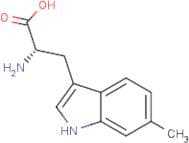
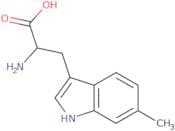
:L-6-Methyltryptophan
Beschreibung:
L-6-Methyltryptophan ist ein Aminosäurederivat und ein strukturelles Analogon von Tryptophan, das durch das Vorhandensein einer Methylgruppe an der Position 6 des Indolrings gekennzeichnet ist. Diese Verbindung ist bekannt für ihre Rolle in verschiedenen biochemischen Prozessen, insbesondere in der Synthese von Proteinen und Neurotransmittern. Sie weist Eigenschaften auf, die typisch für Aminosäuren sind, wie Polarität und die Fähigkeit, Wasserstoffbrücken zu bilden, was ihre Löslichkeit in Wasser und ihre Wechselwirkungen mit anderen Biomolekülen beeinflusst. L-6-Methyltryptophan hat in der Forschung Interesse geweckt aufgrund seiner potenziellen Auswirkungen auf den Serotoninstoffwechsel und seiner Implikationen in der Neurobiologie und Pharmakologie. Darüber hinaus kann es als Vorläufer für die Synthese anderer bioaktiver Verbindungen dienen. Die Verbindung wird typischerweise im Kontext ihrer biologischen Aktivität untersucht, einschließlich ihres Einflusses auf die Stimmungregulation und ihrer potenziellen therapeutischen Anwendungen. Wie bei vielen Aminosäurederivaten können Stabilität und Reaktivität durch Umweltfaktoren wie pH und Temperatur beeinflusst werden.
Formel:C12H14N2O2
InChl:InChI=1S/C12H14N2O2/c1-7-2-3-9-8(5-10(13)12(15)16)6-14-11(9)4-7/h2-4,6,10,14H,5,13H2,1H3,(H,15,16)/t10-/m0/s1
InChI Key:InChIKey=GDMRVYIFGPMUCG-JTQLQIEISA-N
SMILES:C([C@@H](C(O)=O)N)C=1C=2C(NC1)=CC(C)=CC2
Synonyme:- Tryptophan, 6-methyl-, L-
- L-Tryptophan, 6-methyl-
- L-6-Methyltryptophan
- 6-Methyl-L-tryptophan
- (2S)-2-Amino-3-(6-methyl-1H-indol-3-yl)propanoic acid
- (S)-2-Amino-3-(6-methyl-1H-indol-3-yl)propanoic acid
Sortieren nach
Reinheit (%)
0
100
|
0
|
50
|
90
|
95
|
100
2 Produkte.
6-Methyl-L-tryptophan
CAS:6-Methyl-L-tryptophanReinheit:98%Farbe und Form:SolidMolekulargewicht:218.25g/mol6-Methyl-L-tryptophan
CAS:6-Methyl-L-tryptophan is a tryptophan analog that is synthesized from 6-methyl-indole and indole-3-propionic acid. It has been shown to have hemolytic activity against certain strains of bacteria, such as Staphylococcus aureus and Escherichia coli. The biosynthesis of 6-methyl-L-tryptophan is similar to the biosynthesis of L-tryptophan, but with an extra step involving the conversion of anthranilate into indole-3-propionic acid. It also has antiviral properties and can inhibit protein synthesis in viruses. 6MELT is also used in the treatment of malaria because it inhibits the growth of Plasmodium falciparum by interfering with erythrocyte membrane function.Formel:C12H14N2O2Reinheit:Min. 95%Farbe und Form:PowderMolekulargewicht:218.25 g/mol