CAS 33543-55-4
:O-(4-Nitrophenyl)hydroxylamin
Beschreibung:
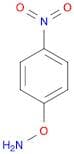
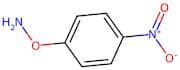
O-(4-Nitrophenyl)hydroxylamin ist eine organische Verbindung, die durch das Vorhandensein einer Hydroxylamin-Funktionalgruppe gekennzeichnet ist, die an ein Para-Nitrophenyl-Moiety gebunden ist. Ihre molekulare Struktur weist eine Nitrogruppe (-NO2) auf, die in der Para-Position relativ zur Hydroxylamin-Gruppe (-NH2OH) positioniert ist, was zu ihrer chemischen Reaktivität und ihren Eigenschaften beiträgt. Diese Verbindung ist typischerweise ein gelbes kristallines Feststoff, das die Anwesenheit der Nitrogruppe widerspiegelt, die ihre elektronischen Eigenschaften und Löslichkeit beeinflussen kann. O-(4-Nitrophenyl)hydroxylamin ist bekannt für seine Anwendungen in der organischen Synthese, insbesondere bei der Herstellung verschiedener Derivate und als Reagenz in der analytischen Chemie. Sie kann an nucleophilen Substitutionsreaktionen teilnehmen und wird häufig zur Detektion von Carbonylverbindungen durch Derivatisierung verwendet. Darüber hinaus kann sie aufgrund ihrer Nitrogruppe einen gewissen Grad an biologischer Aktivität aufweisen, was sie in der medizinischen Chemie von Interesse macht. Eine ordnungsgemäße Handhabung und Lagerung sind unerlässlich, wie bei vielen Nitroverbindungen, aufgrund der potenziellen Gefahren, die mit ihrer Reaktivität und Toxizität verbunden sind.
Formel:C6H6N2O3
InChl:InChI=1S/C6H6N2O3/c7-11-6-3-1-5(2-4-6)8(9)10/h1-4H,7H2
InChI Key:InChIKey=OOHKBWPOLBTKMR-UHFFFAOYSA-N
SMILES:N(=O)(=O)C1=CC=C(ON)C=C1
Synonyme:- 1-(Aminooxy)-4-nitrobenzene
- Hydroxylamine, O-(p-nitrophenyl)-
- O-(p-Nitrophenyl)hydroxylamine
- hydroxylamine, O-(4-nitrophenyl)-
- p-Nitrophenoxyamine
- O-(4-Nitrophenyl)hydroxylamine
- O-(4-Nitrophenyl)hydroxylamine
Sortieren nach
Reinheit (%)
0
100
|
0
|
50
|
90
|
95
|
100
4 Produkte.
O-(4-Nitrophenyl)hydroxylamine
CAS:O-(4-Nitrophenyl)hydroxylamineReinheit:98%Molekulargewicht:154.12g/molO-(4-Nitrophenyl)hydroxylamine
CAS:O-(4-Nitrophenyl)hydroxylamine (OPH) is an enantioselective, catalytic, and thermal stable reagent for the synthesis of chiral methyl groups. OPH can be used as a nucleophile to convert electron-deficient alkenes into α-chloroalkenes. It also reacts with nitroarenes to give nitroalkenes in high yields. OPH has been shown to be effective in the asymmetric hydrolysis of esters and amides through its ability to oxidize the methyl group on the substrate. This reaction does not occur with other groups such as hydroxyl or hydrogen atoms. Methyl groups are important for many biological molecules, including proteins and nucleic acids, which form the backbone of cells that make up living organisms. The OPH reaction is catalyzed by enzymes called methyltransferases, which transfer one atom of methyl from S-adenosylmethionine (SAM)Formel:C6H6N2O3Reinheit:Min. 95%Farbe und Form:PowderMolekulargewicht:154.12 g/mol