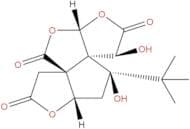
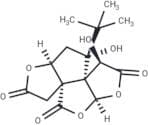
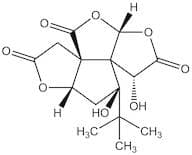
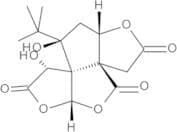
CAS 33570-04-6
:Bilobalid
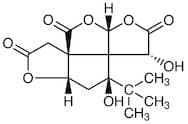
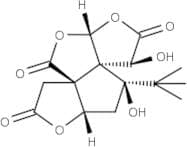
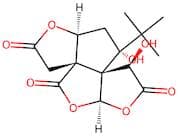
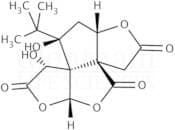
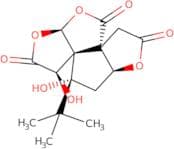
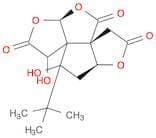
- (3aS,5aR,8R,8aS,9R,10aS)-9-(1,1-Dimethylethyl)-10,10a-dihydro-8,9-dihydroxy-4H,5aH,9H-furo[2,3-b]furo[3′,2′:2,3]cyclopenta[1,2-c]furan-2,4,7(3H,8H)-trione
- (3aS,5aS,9R,10aS)-9-tert-butyl-8,9-dihydroxydihydro-9H-furo[2,3-b]furo[3',2':2,3]cyclopenta[1,2-c]furan-2,4,7(3H,8H)-trione
- 4H,5aH,9H-Furo[2,3-b]furo[3′,2′:2,3]cyclopenta[1,2-c]furan-2,4,7(3H,8H)-trione, 9-(1,1-dimethylethyl)-10,10a-dihydro-8,9-dihydroxy-, (3aS,5aR,8R,8aS,9R,10aS)-
- 4H,5aH,9H-Furo[2,3-b]furo[3′,2′:2,3]cyclopenta[1,2-c]furan-2,4,7(3H,8H)-trione, 9-(1,1-dimethylethyl)-10,10a-dihydro-8,9-dihydroxy-, [5aR-(3aS*,5aα,8β,8aS*,9α,10aα)]-
- 4H,5aH,9H-Furo[2,3-b]furo[3′,2′:2,3]cyclopenta[1,2-c]furan-2,4,7(3H,8H)-trione, 9α-tert-butyl-10,10aβ-dihydro-8α,9-dihydroxy-, (-)-
- Bilobalid
- Bilobalide
Bilobalide
CAS:Formel:C15H18O8Reinheit:>96.0%(GC)Farbe und Form:White to Almost white powder to crystalMolekulargewicht:326.30(-)-Bilobalide
CAS:(-)-Bilobalide analytical standard provided with w/w absolute assay, to be used for quantitative titration.Formel:C15H18O8Reinheit:(HPLC) ≥99%Farbe und Form:PowderMolekulargewicht:326.3Bilobalide
CAS:Bilobalide ((-)-Bilobalide), a bioactive from Gingko Biloba, is active on hypoxia-induced alterations.Formel:C15H18O8Reinheit:98.81% - 99.92%Farbe und Form:White SolidMolekulargewicht:326.30(-)-bilobalide
CAS:LactoneFormel:C15H18O8Reinheit:≥ 95.0 % (HPLC)Farbe und Form:PowderMolekulargewicht:326.3Bilobalide
CAS:Kontrolliertes ProduktStability Hygroscopic
Applications Bilobalide provides protection against learning and memory impairment by reducing free radical injury and inhibiting neuronal apoptosis in the brain cortex and hippocampal CA1 region in induced vascular dementia rats.
References Li, W., et. al.: Mol. Med. Reports, 8, 935 (2013)Formel:C15H18O8Farbe und Form:Off WhiteMolekulargewicht:326.3Bilobalide
CAS:Bilobalide is a sesquiterpene trilactone, which is a secondary metabolite isolated from the leaves of the Ginkgo biloba tree. The source of bilobalide, Ginkgo biloba, is one of the oldest tree species, extensively studied for its wide array of bioactive compounds. Bilobalide exerts its mode of action predominantly through modulation of various neurotransmitter systems and protection against neuronal injury. It has demonstrated the ability to antagonize the GABAA receptor and inhibit excitotoxicity related to excessive glutamate release, thereby providing neuroprotective effects.
Formel:C15H18O8Reinheit:Min. 95%Farbe und Form:White PowderMolekulargewicht:326.3 g/mol