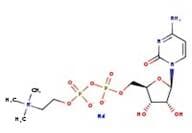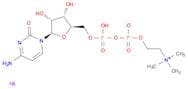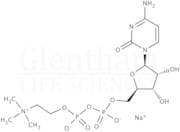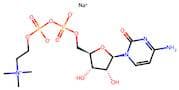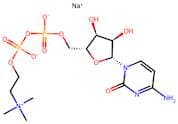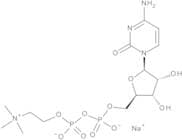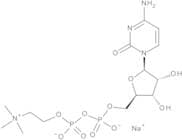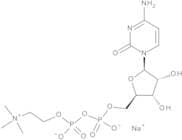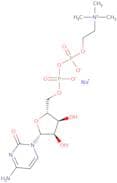
CAS 33818-15-4
:Citicolin-Natrium
- Acticolin
- Brassel
- Cebroton
- CerAxon
- Choline, hydroxide, monoester with cytidine 5′-(trihydrogen pyrophosphate), inner salt, monosodium salt
- Cidifos
- Citicoline Sodium
- Cytidine 5'-(Trihydrogen Diphosphate) P'-(2-(Trimethylammonio)Ethyl) Ester Inner Salt Monosodium Salt
- Cytidine 5′-(trihydrogen diphosphate), P′-[2-(trimethylammonio)ethyl] ester, hydroxide, inner salt, monosodium salt
- Cytidine 5′-(trihydrogen diphosphate), P′-[2-(trimethylammonio)ethyl] ester, inner salt, sodium salt (1:1)
- Flussorex
- Gerolin
- IP 302 sodium
- Logan
- Neurotron
- Sinkron
- Strolin
- Weitere Synonyme anzeigen
Cytidine-5'-diphosphocholine sodium salt
CAS:Intermediate in the synthesis of phosphatidylcholine; also a phospholipase inhibitorFormel:C14H25N4NaO11P2Farbe und Form:White, Powder or crystals or crystalline powderMolekulargewicht:510.31Citicoline Sodium
CAS:Nucleic acids and their salts, whether or not chemically defined; other heterocyclic compounds, nesoiFormel:C14H25N4NaO11P2Farbe und Form:White PowderMolekulargewicht:510.08928Citicoline sodium
CAS:Citicoline sodium aids in making phosphatidylcholine and acetylcholine, protects the brain from trauma, and improves memory.Formel:C14H25N4NaO11P2Reinheit:99.26% - 99.37%Farbe und Form:White SolidMolekulargewicht:510.31sodium 2-(trimethylazaniumyl)ethyl ({[(2R,3S,4R,5R)-5-(4-amino-2-oxo-1,2-dihydropyrimidin-1-yl)-3,4-dihydroxyoxolan-2-yl]methyl phosphonato}oxy)phosphonate
CAS:Formel:C14H25N4NaO11P2Reinheit:97%Farbe und Form:SolidMolekulargewicht:510.3058Citicoline sodium salt
CAS:Formel:C14H25N4NaO11P2·xH2OReinheit:≥ 98.0% (anhydrous basis)Farbe und Form:White to almost white crystalline powderMolekulargewicht:511.31 (anhydrous)Citicoline Sodium Salt (CDP-Choline Sodium Salt)
CAS:Formel:C14H25N4O11P2·NaMolekulargewicht:487.32 22.99Cytidine 5'-Diphosphocholine Sodium Salt
CAS:Formel:C14H25N4NaO11P2Reinheit:>95.0%(T)Farbe und Form:White to Almost white powder to crystalMolekulargewicht:510.31Citicoline Sodium Salt
CAS:Applications Naturally occurring nucleotide; intermediate in the major pathway of lecitin biosynthesis. Neuroprotective. It is used in the treatment of ischemic stroke and head trauma. Neuroprotective product. Citicholine exhibits protective effects in cerebral ischemia, traumatic brain injury, and memory disorders. Recently showed efficacy against dementia when given with AchEIs (Acetylcholinesterase inhibitor) (1). Depicts Neuroprotective, acnticonvulsant activity and sedative effect at a dose of 150mg/kg in rats. (2). Showed protection against aluminum induced cognitive impairment in rats reducing elevated glutamate level, oxidative stress and NO overproduction in the hippocampus.
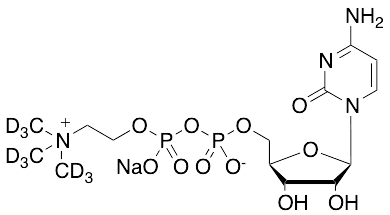
References Castagna A, et al. Clin Drug Investig. 2016 Sep 1 Abdolmaleki A, et al. 2016. Eur J Pharmacol. Oct 15;789:275-9Abdel-Zaher AO et al. Toxicol Ind Health. 2016 May 13Formel:C14H25N4O11P2·NaFarbe und Form:WhiteMolekulargewicht:510.31Citicoline-d9 Sodium Salt
CAS:Kontrolliertes ProduktApplications Labelled Citicoline (C508050). Naturally occurring nucleotide; intermediate in the major pathway of lecitin biosynthesis. Neuroprotective. It is used in the treatment of ischemic stroke and head trauma.
References Kennedy, E.P., et al.: J. Biol. Chem., 222, 185 (1956), Rao, A., et al.: J. Neurosci. Res., 58, 697 (1999), Wurtman, R., et al.: Biochem. Pharmacol., 60, 989 (2000),Formel:C14D9H16N4NaO11P2Farbe und Form:NeatMolekulargewicht:519.361Citicoline sodium
CAS:Citicoline is a complex organic molecule, a form of B-vitamin choline that acts as an intermediate in many biosynthetic pathways, for example, in the biosynthesis of cell membrane phospholipids. As a dietary supplement, citicoline is a source of choline and cytidine, two components that are quickly absorbed in the intestine and across the blood-brain barrier. The neuroprotective properties of citicoline improves mental performance increasing the levels of other brain-related chemicals like dopamine and norepinephrine, helping with recovery in stroke patients, reducing memory loss due to aging and improving vision in patients with glaucoma.Formel:C14H26N4O11P2•NaReinheit:Min. 98.0 Area-%Farbe und Form:White To Off-White SolidMolekulargewicht:511.31 g/mol