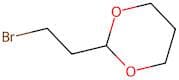
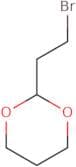
CAS 33884-43-4
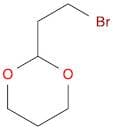
:2-(2-Bromethyl)-1,3-dioxan
- 1,3-Dioxane, 2-(2-bromoethyl)-
- 2-(1,3-Dioxan-2-yl)ethyl bromide
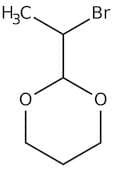
- 2-(1-Bromoethyl)-1,3-Dioxane
- 2-(β-Bromoethyl)-1,3-dioxane
- 2-Bromopropanal 1,3-propanediol acetal
- 2-Bromopropionaldehyde trimethylene acetal
- 3,3-(Trimethylenedioxy)propyl bromide
- m-Dioxane, 2-(2-bromoethyl)-
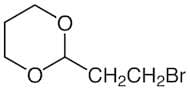
- 2-(2-Bromoethyl)-1,3-dioxane
2-(2-Bromoethyl)-1,3-dioxane, 98%
CAS:2-(2-Bromoethyl)-1,3-dioxane, Provides a useful means of introducing a masked -formylethyl group. In comparison with the corresponding dioxolane (following entry), the dioxane is more stable to acid, and the Grignard is thermally stable. Reaction of the Grignard with an acid chloride gives the ketonFormel:C6H11BrO2Reinheit:98%Farbe und Form:Liquid, Clear colorless to yellowMolekulargewicht:195.062-(2-Bromoethyl)-1,3-dioxane
CAS:Formel:C6H11BrO2Reinheit:97%Farbe und Form:LiquidMolekulargewicht:195.05432-(2-Bromoethyl)-1,3-dioxane
CAS:Formel:C6H11BrO2Reinheit:≥ 98.0%Farbe und Form:Colourless liquidMolekulargewicht:195.052-(2-Bromoethyl)-1,3-dioxane
CAS:Formel:C6H11BrO2Reinheit:>97.0%(GC)Farbe und Form:Colorless to Amber clear liquidMolekulargewicht:195.062-(2-Bromoethyl)-1,3-dioxane
CAS:2-(2-Bromoethyl)-1,3-dioxaneReinheit:98%Molekulargewicht:195.05g/mol2-(2-Bromoethyl)-1,3-Dioxane
CAS:Formel:C6H11BrO2Reinheit:97%Farbe und Form:Liquid, ClearMolekulargewicht:195.0562-(2-Bromoethyl)-1,3-dioxane
CAS:Kontrolliertes ProduktApplications 2-(2-Bromoethyl)-1,3-dioxane, is an building block used for the synthesis of various pharmaceutical compounds such as Oxaflumazine (O758550), an Antipsychotic. It provides a useful means of introducing a masked ß-formylethyl group.
References Marrero-Ponce, Y., et al.: Euro. J. Med. Chem., 46 (12), 5736 (2011); J. Org. Chem., 41, 560 (1976);Formel:C6H11BrO2Farbe und Form:NeatMolekulargewicht:195.052-(2-Bromoethyl)-1,3-dioxane
CAS:2-(2-Bromoethyl)-1,3-dioxane is a palladium complex with the formula (CHBr)Pd(OEt)(NH). It is used as a catalyst in asymmetric synthesis. 2-(2-Bromoethyl)-1,3-dioxane has been investigated for use as an inhibitor of glycosidases and aminoglycoside acetyltransferase. This compound also inhibits tumor cell line growth. The mechanism of action is not fully elucidated but may be related to its ability to form an amide bond to the amino group of the substrate.
Formel:C6H11BrO2Reinheit:Min. 95%Farbe und Form:Colorless Clear LiquidMolekulargewicht:195.05 g/mol