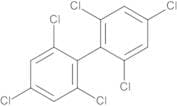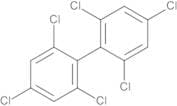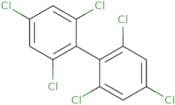
CAS 33979-03-2
:PCB 155
- 1,1′-Biphenyl, 2,2′,4,4′,6,6′-hexachloro-
- 2,2′,4,4′,6,6′-Hcb
- 2,2′,4,4′,6,6′-Hexachloro-1,1′-biphenyl
- 2,2′,4,4′,6,6′-Hexachlorobiphenyl
- 2,2′,4,4′,6,6′-Hexachlorodiphenyl
- 2,4,6,2′,4′,6′-Hexachlorobiphenyl
- Biphenyl, 2,2′,4,4′,6,6′-hexachloro-
- Pcb-155
PCB No. 155 10 µg/mL in Isooctane
CAS:Kontrolliertes ProduktFormel:C12H4Cl6Farbe und Form:Single SolutionMolekulargewicht:360.882,2',4,4',6,6'-Hexachlorobiphenyl
CAS:Kontrolliertes ProduktFormel:C12H4Cl6Farbe und Form:NeatMolekulargewicht:360.882,2',4,4',6,6'-Hexachlorobiphenyl
CAS:Kontrolliertes Produkt2,2',4,4',6,6'-Hexachlorobiphenyl (PCB-136) is a potent anticancer agent that has been shown to induce apoptosis in cancer cells. It acts as a kinase inhibitor by blocking the activity of specific kinases involved in tumor growth and progression. PCB-136 has been studied extensively in human and Chinese hamster ovary cells and has been found to be highly effective against various types of cancer. This medicinal analog also exhibits inhibitory effects on the protein kinases that regulate cell division and proliferation, making it a promising candidate for cancer therapy. In addition, PCB-136 shows potential for use as a urinary biomarker for exposure to environmental pollutants due to its persistence in the environment and ability to accumulate in body tissues.
Formel:C12H4Cl6Reinheit:Min. 95%Molekulargewicht:360.9 g/mol