

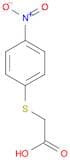
![[(4-nitrophenyl)sulfanyl]acetic acid](/_next/image/?url=https%3A%2Fstatic.cymitquimica.com%2Fcas-image%2Fthumb-webp%2F157410-4-nitrophenyl-sulfanyl-acetic-acid.webp&w=3840&q=75)
CAS 3406-75-5
:[(4-Nitrophenyl)sulfanyl]essigsäure
Beschreibung:
[(4-Nitrophenyl)sulfanyl]essigsäure, mit der CAS-Nummer 3406-75-5, ist eine organische Verbindung, die durch das Vorhandensein sowohl einer Nitrofenylgruppe als auch einer Sulfanylgruppe (Thio) gekennzeichnet ist, die an eine Acetylsäureeinheit gebunden ist. Diese Verbindung erscheint typischerweise als Feststoff bei Raumtemperatur und ist in polaren Lösungsmitteln löslich, was auf das Vorhandensein der carboxylischen Säurefunktion zurückzuführen ist. Die Nitrogruppe trägt zu ihren elektronenziehenden Eigenschaften bei, die ihre Reaktivität und Wechselwirkungen in chemischen Reaktionen beeinflussen können. Die Sulfanylgruppe führt Schwefel in die Struktur ein, der an verschiedenen chemischen Umwandlungen, einschließlich nucleophiler Substitutionen, teilnehmen kann. Diese Verbindung kann biologische Aktivität aufweisen, was sie in der medizinischen Chemie und in Forschungsanwendungen von Interesse macht. Ihre Eigenschaften, wie Schmelzpunkt, Siedepunkt und spezifische Reaktivität, können je nach Reinheit und spezifischen Bedingungen, unter denen sie gehandhabt wird, variieren. Sicherheitsvorkehrungen sollten beim Arbeiten mit dieser Verbindung beachtet werden, da sie aufgrund der Anwesenheit der Nitrogruppe Gesundheitsrisiken darstellen kann.
Formel:C8H7NO4S
InChl:InChI=1/C8H7NO4S/c10-8(11)5-14-7-3-1-6(2-4-7)9(12)13/h1-4H,5H2,(H,10,11)
SMILES:c1cc(ccc1N(=O)=O)SCC(=O)O
Synonyme:- Acetic Acid, 2-[(4-Nitrophenyl)Thio]-
Sortieren nach
Reinheit (%)
0
100
|
0
|
50
|
90
|
95
|
100
4 Produkte.
[(4-Nitrophenyl)sulphanyl]acetic acid
CAS:[(4-Nitrophenyl)sulphanyl]acetic acid
Formel:C8H7NO4SReinheit:95+% (Typical Value in Batch COA)Farbe und Form: solidMolekulargewicht:213.21g/mol2-[(4-Nitrophenyl)sulfanyl]acetic acid
CAS:2-[(4-Nitrophenyl)sulfanyl]acetic acid is a colorless liquid with a boiling point of 168°C. It is soluble in water, glycol, and ether, but not in ethanol. 2-[(4-Nitrophenyl)sulfanyl]acetic acid has been shown to be an acceptor for borate, forming the perborate ion. It also reacts with glycol to form the glyoxalate ion. The compound has been shown to react with nitric acid and ethylene glycol to form nitroethane and acetic acid molecules. This reaction is catalyzed by hydrogen bonding between the oxygen atoms of acetic acid and nitric acid, which causes an electron transfer from nitric acid to acetic acid molecules. This process results in reactive species that can then react with other substances such as hydrogen bonds or peracetic acid.Formel:C8H7NO4SReinheit:Min. 95%Molekulargewicht:213.21 g/mol

![[(4-Nitrophenyl)sulphanyl]acetic acid](/_next/image/?url=https%3A%2Fstatic.cymitquimica.com%2Fproducts%2F54%2Fthumb%2FOR14293.jpg&w=3840&q=75)

![2-[(4-Nitrophenyl)sulfanyl]acetic acid](/_next/image/?url=https%3A%2Fstatic.cymitquimica.com%2Fproducts%2F10%2Fthumb%2FF636126.jpg&w=3840&q=75)

![2-[(4-Nitrophenyl)sulfanyl]acetic acid](/_next/image/?url=https%3A%2Fstatic.cymitquimica.com%2Fproducts%2F3D%2Fthumb%2FDAA40675.jpg&w=3840&q=75)
