CAS 342-10-9
:Kallidin
Beschreibung:
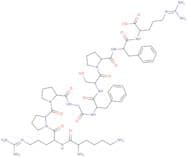
Kallidin, auch bekannt als Lysin-Bradykinin, ist ein Peptid, das eine bedeutende Rolle bei der Regulierung des Blutdrucks und der entzündlichen Reaktionen spielt. Es gehört zur Familie der Kinin, die biologisch aktive Peptide sind, die aus Kininogen durch die Wirkung spezifischer Enzyme abgeleitet werden. Kallidin zeichnet sich durch seine Fähigkeit aus, eine Vasodilatation zu induzieren, die Gefäßpermeabilität zu erhöhen und Schmerzrezeptoren zu stimulieren, was zu seiner Rolle in entzündlichen Prozessen beiträgt. Das Peptid besteht aus einer Sequenz von Aminosäuren, wobei Lysin ein Schlüsselbestandteil ist, der es von anderen Kinin wie Bradykinin unterscheidet. Kallidin wird im Körper als Reaktion auf Gewebeverletzungen oder Stress produziert, und seine Wirkungen werden über spezifische Rezeptoren vermittelt, die als Bradykininrezeptoren bekannt sind. Aufgrund seiner physiologischen Funktionen ist Kallidin in verschiedenen Bereichen von Interesse, einschließlich der Pharmakologie und der kardiovaskulären Forschung. Seine CAS-Nummer, 342-10-9, wird zur Identifizierung in chemischen Datenbanken und regulatorischen Kontexten verwendet.
Formel:C56H85N17O12
InChl:InChI=1/C56H85N17O12/c57-24-8-7-18-36(58)46(76)67-37(19-9-25-63-55(59)60)51(81)73-29-13-23-44(73)53(83)72-28-11-21-42(72)49(79)65-32-45(75)66-39(30-34-14-3-1-4-15-34)47(77)70-41(33-74)52(82)71-27-12-22-43(71)50(80)69-40(31-35-16-5-2-6-17-35)48(78)68-38(54(84)85)20-10-26-64-56(61)62/h1-6,14-17,36-44,74H,7-13,18-33,57-58H2,(H,65,79)(H,66,75)(H,67,76)(H,68,78)(H,69,80)(H,70,77)(H,84,85)(H4,59,60,63)(H4,61,62,64)
SMILES:c1ccc(cc1)CC(C(=NC(CO)C(=O)N1CCCC1C(=NC(Cc1ccccc1)C(=NC(CCCNC(=N)N)C(=O)O)O)O)O)N=C(CN=C(C1CCCN1C(=O)C1CCCN1C(=O)C(CCCNC(=N)N)N=C(C(CCCCN)N)O)O)O
Synonyme:- Bradykinin, N2-L-lysyl-
- lysyl-N~5~-(diaminomethylidene)ornithylprolylprolylglycylphenylalanylserylprolylphenylalanyl-N~5~-(diaminomethylidene)ornithine
Sortieren nach
Reinheit (%)
0
100
|
0
|
50
|
90
|
95
|
100
5 Produkte.
Lys-Bradykinin
CAS:Kallidin is the precursor of the vasodilator bradykinin.Formel:C56H85N17O12Reinheit:96.38%Farbe und Form:White LyophilisateMolekulargewicht:1188.4Lys-Bradykinin
CAS:Endogenous bradykinin receptor agonistFormel:C56H85N17O12Reinheit:98%Farbe und Form:SolidMolekulargewicht:1188.382-[[2-[[1-[2-[[2-[[2-[[1-[1-[2-(2,6-Diaminohexanoylamino)-5-(diaminomethylideneamino)pentanoyl]pyrrolidine-2-carbonyl]pyrrolidine-2- carbonyl]amino]acetyl]amino]-3-phenylpropanoyl]amino]-3-hydroxypropanoyl]pyrrolidine-2-carbonyl]amino]-3-phenylpropanoyl]a
CAS:Custom research peptide; min purity 95%. For different specs please use the Peptide Quote Tool
Formel:C56H85N17O12Molekulargewicht:1,188.38 g/molLysyl-Bradykinin (Kallidin) (Human, Bovine)
CAS:Kontrolliertes ProduktLysyl-bradykinin (kallidin) is a peptide that is a potent activator of non-selective cation channels. It has been shown to activate potassium channels and calcium channels, but not sodium channels. The activation by lysyl-bradykinin leads to an increase in the permeability of the membrane, which can lead to release of neurotransmitters from nerve endings. Lysyl-bradykinin also has been shown to be an inhibitor of protein interactions with the receptor in certain cell lines. The antibody used to measure this inhibition is L1420.Formel:C56H85N17O12Reinheit:Min. 95%Molekulargewicht:1,188.40 g/molLys-Bradykinin acetate salt
CAS:Lys-Bradykinin is a peptide that is a member of the group of kinins. It has been shown to be effective at inhibiting the activity of kallikrein, which is an enzyme that converts kininogen to bradykinin. This inhibition lowers the levels of bradykinin in the blood and may be used as a diagnostic tool for identifying diseases such as congestive heart failure, pulmonary edema, and acute renal failure. Lys-Bradykinin can also be used as a model system for studying kinins and their biological effects on various systems. For example, it has been shown to have natriuretic properties in humans by increasing levels of erythropoietin and ANP.Formel:C56H85N17O12Reinheit:Min. 95%Molekulargewicht:1,188.38 g/mol


![2-[[2-[[1-[2-[[2-[[2-[[1-[1-[2-(2,6-Diaminohexanoylamino)-5-(diaminomethylideneamino)pentanoyl]pyr…](/_next/image/?url=https%3A%2Fstatic.cymitquimica.com%2Fproducts%2F3D%2Fthumb%2FPP50785.jpg&w=3840&q=75)