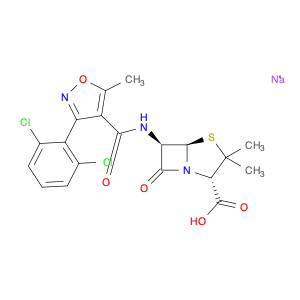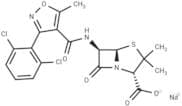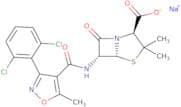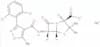
CAS 343-55-5
:Dicloxacillin-Natrium
- 4-Thia-1-azabicyclo(3.2.0)heptane-2-carboxylic acid, 6-(((3-(2,6-dichlorophenyl)-5-methyl-4-isoxazolyl)carbonyl)amino)-3,3-dimethyl-7-oxo-, monosodium salt, (2S,5R,6R)-
- 4-Thia-1-azabicyclo(3.2.0)heptane-2-carboxylic acid, 6-(((3-(2,6-dichlorophenyl)-5-methyl-4-isoxazolyl)carbonyl)amino)-3,3-dimethyl-7-oxo-, monosodium salt, (2S-(2alpha,6beta))-
- 4-Thia-1-azabicyclo(3.2.0)heptane-2-carboxylic acid, 6-(3-(2,6-dichlorophenyl)-5-methyl-4-isoxazolecarboxamido)-3,3-dimethyl-7-oxo-, monosodium salt
- 4-Thia-1-azabicyclo[3.2.0]heptane-2-carboxylic acid, 6-[[[3-(2,6-dichlorophenyl)-5-methyl-4-isoxazolyl]carbonyl]amino]-3,3-dimethyl-7-oxo-, monosodium salt, [2S-(2α,5α,6β)]-
- 4-Thia-1-azabicyclo[3.2.0]heptane-2-carboxylic acid, 6-[[[3-(2,6-dichlorophenyl)-5-methyl-4-isoxazolyl]carbonyl]amino]-3,3-dimethyl-7-oxo-, sodium salt (1:1), (2S,5R,6R)-
- Brispen
- Constaphyl
- Dichlor-Stapenor
- Diclocil
- Dicloxacillin sodium anhydrous
- Dycill
- Dynapen
- Noxaben
- P 1011
- Pathocil
- Pen-Sint
- Sodium (2S-(2alpha,5alpha,6beta))-6-(((3-(2,6-dichlorophenyl)-5-methylisoxazol-4-yl)carbonyl)amino)-3,3-dimethyl-7-oxo-4-thia-1-azabicyclo(3.2.0)heptane-2-carboxylate
- Sodium (3-(2,6-dichlorophenyl)-5-methyl-4-isoxazolyl)penicillin
- Sodium 6-({[3-(2,6-Dichlorophenyl)-5-Methylisoxazol-4-Yl]Carbonyl}Amino)-3,3-Dimethyl-7-Oxo-4-Thia-1-Azabicyclo[3.2.0]Heptane-2-Carboxylate
- Sodium dicloxacillin
- Stampen
- Weitere Synonyme anzeigen
Dicloxacillin Sodium
CAS:Formel:C19H16Cl2N3NaO5SReinheit:97%Farbe und Form:SolidMolekulargewicht:492.3082Dicloxacillin Sodium Salt
CAS:Formel:C19H16Cl2N3O5S·NaFarbe und Form:White To Off-White SolidMolekulargewicht:469.31 22.99Dicloxacillin Sodium
CAS:Dicloxacillin Sodium (BRL1702 Sodium) is a β-lactamase resistant penicillin similar to oxacillin and it has activity against gram-positive/negative bacteria.Formel:C19H17Cl2N3O5S·H2O·NaReinheit:98%Farbe und Form:SolidMolekulargewicht:510.32Dicloxacillin sodium salt
CAS:Dicloxacillin is a penicillin antibiotic that is used to treat bacterial infections of the gastrointestinal tract, skin, and urinary tract. It binds to the penicillin-binding proteins in bacterial cell walls by competitive inhibition. Dicloxacillin inhibits bacterial growth by binding to the enzyme cell wall synthesis that is required for cell wall biosynthesis, inhibiting protein synthesis and cell division. This drug also has a toxic effect on respiratory system cells, which may be due to its ability to induce apoptosis. Dicloxacillin sodium salt is available as tablets for oral administration or as an intravenous solution for injection. It can interact with other drugs, such as benzalkonium chloride and matrix effect; it also has analytical methods such as chromatographic analysis and rate constant.
Formel:C19H17Cl2N3O5S·NaReinheit:Min. 95%Molekulargewicht:493.32 g/mol