CAS 344-25-2
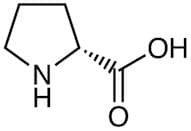
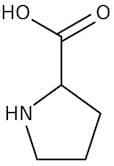
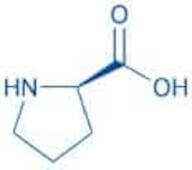
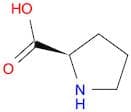
:D-Prolin
Beschreibung:
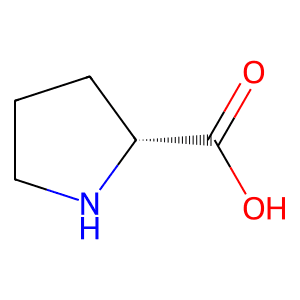
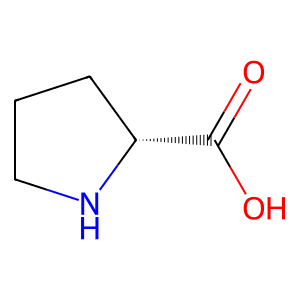
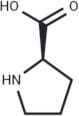
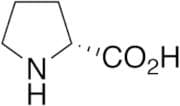
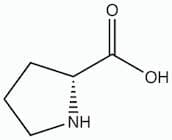
D-Prolin ist eine natürlich vorkommende Aminosäure, die als nicht essentielle Aminosäure klassifiziert ist, was bedeutet, dass der Körper sie synthetisieren kann. Sie zeichnet sich durch ihre einzigartige zyklische Struktur aus, die einen fünfgliedrigen Ring umfasst, der aus der Aminogruppe und der Seitenkette gebildet wird, was zu ihren charakteristischen Eigenschaften beiträgt. D-Prolin ist bekannt für seine Rolle bei der Proteinsynthese und ist besonders wichtig für die Bildung von Kollagen, einem Schlüsselstrukturprotein im Bindegewebe. Es zeigt eine chirale Natur, wobei D-Prolin eines der beiden Enantiomere von Prolin ist, das andere ist L-Prolin, das häufiger in Proteinen vorkommt. D-Prolin ist in Wasser löslich und hat einen relativ hohen Schmelzpunkt im Vergleich zu anderen Aminosäuren. Seine Präsenz in verschiedenen biologischen Prozessen, einschließlich zellulärer Signalgebung und Osmoregulation, hebt seine Bedeutung in der Biochemie hervor. Darüber hinaus wurde D-Prolin auf seine potenziellen therapeutischen Anwendungen untersucht, einschließlich seiner Rolle bei der Neuroprotektion und als Vorläufer bei der Synthese verschiedener Arzneimittel.
Formel:C5H9NO2
InChl:InChI=1S/C5H9NO2/c7-5(8)4-2-1-3-6-4/h4,6H,1-3H2,(H,7,8)/t4-/m1/s1
InChI Key:InChIKey=ONIBWKKTOPOVIA-SCSAIBSYSA-N
SMILES:C(O)(=O)[C@H]1CCCN1
Synonyme:- (+)-(R)-Proline
- (2R)-Pyrrolidin-1-ium-2-carboxylate
- (2R)-Pyrrolidine-2-carboxylic acid
- (R)-2-Carboxypyrrolidine
- (R)-Pyrrolidine-2-carboxylic acid
- <span class="text-smallcaps">D</span>-(+)-Proline
- D-(+)-Prolin
- D-(+)-prolina
- D-Pyrrolidine-2-carboxylic acid
- H-D-Pro-OH
- Proline, <span class="text-smallcaps">D</span>-
- Proline, D-
- D-Proline
- Weitere Synonyme anzeigen
Sortieren nach
Reinheit (%)
0
100
|
0
|
50
|
90
|
95
|
100
14 Produkte.
D-Proline
CAS:Formel:C5H9NO2Reinheit:>98.0%(T)Farbe und Form:White to Almost white powder to crystalMolekulargewicht:115.13D-Proline, 99%
CAS:D-Proline is an essential component of collagen and is important for proper functioning of joints and tendons. It is also used as asymmetric catalysts in proline organocatalysis reactions. This Thermo Scientific Chemicals brand product was originally part of the Alfa Aesar product portfolio. Some doFormel:C5H9NO2Reinheit:99%Farbe und Form:Crystals or powder or crystalline powder, White to pale creamMolekulargewicht:115.13H-D-Pro-OH
CAS:Bachem ID: 4031089.
Formel:C5H9NO2Reinheit:> 99%Farbe und Form:WhiteMolekulargewicht:115.13(R)-pyrrolidine-2-carboxylic acid
CAS:(R)-pyrrolidine-2-carboxylic acid
Reinheit:≥98%Molekulargewicht:115.13g/molD-Proline
CAS:Formel:C5H9NO2Reinheit:98.0 - 101.0 %Farbe und Form:White to off-white powderMolekulargewicht:115.13D-Proline
CAS:D-ProlineFormel:C5H9NO2Reinheit:98%Farbe und Form: faint yellow crystalline needlesMolekulargewicht:115.13046g/mol(2R)-Pyrrolidine-2-carboxylic acid
CAS:(2R)-Pyrrolidine-2-carboxylic acidFormel:C5H9NO2Reinheit:≥95%Farbe und Form: white to off-white solidMolekulargewicht:115.13g/mol(R)-pyrrolidine-2-carboxylic acid
CAS:D-Proline, (R)-pyrrolidine-2-carboxylic acid, is L-Proline's isomer, found in human plasma/saliva, possibly from bacteria or racemase activity.Formel:C5H9NO2Reinheit:99.88%Farbe und Form:Flat Needles From Alcohol + Ether; Prisms From Water SolidMolekulargewicht:115.13D-Proline
CAS:D-Proline is a non-essential amino acid that can be synthesized by the body. It is a racemic mixture of the two stereoisomers, L-proline and D-proline. Research has shown that D-proline inhibits the enzyme racemase, which converts L-proline to D-proline. Racemase inhibition leads to an accumulation of L-proline, which may reduce disease activity in some cases. D-Proline also inhibits liver cells and trigeminal nerve cells, leading to decreased pain. The asymmetric synthesis of picolinic acid from D-pyridoxal 5'-phosphate catalyzed by prolinase occurs at a pH optimum around 2.8. This reaction is used as a model system for studying chemical biology and antimicrobial peptides. D-Proline can be found in E coli K12 and other bacteria with analytical chemistry techniques such as gas chromatography mass spectrometry (GCFormel:C5H9NO2Farbe und Form:PowderMolekulargewicht:115.13 g/molD-Proline extrapure CHR, 99%
CAS:Formel:C5H9NO2Reinheit:min. 99%Farbe und Form:White to off-white, Crystalline powder, Clear, Colourless to faint yellowMolekulargewicht:115.13