


CAS 34422-12-3
:Elenolsäure
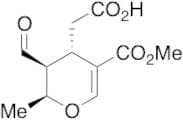
- (2S,3S,4S)-3-Formyl-3,4-dihydro-5-(methoxycarbonyl)-2-methyl-2H-pyran-4-acetic acid
- 2H-Pyran-4-acetic acid, 3-formyl-3,4-dihydro-5-(methoxycarbonyl)-2-methyl-, (2S,3S,4S)-
- 2H-Pyran-4-acetic acid, 3-formyl-3,4-dihydro-5-(methoxycarbonyl)-2-methyl-, [2S-(2α,3α,4β)]-
- Elenaic Acid
- Elenolic acid
- Glutaric acid, 3-(1-formylpropenyl)-2-(hydroxymethylene)-, 1-methyl ester
Elenolic Acid (>90%)
CAS:Applications Elenolic Acid is an antiviral agent that inhibits reverse transcriptases, inhibited the growth of chicken embryo fibroblast cells as well as Escherichia coli and Bacillus subtilis strains.
References Heinze, J.E., et al.: Antimicrob. Agents Chemother., 8, 421 (1975); Renis, H,E..: Antimicrob. Agents Chemother., 8, 149 (1975)Formel:C11H14O6Reinheit:>90%Farbe und Form:NeatMolekulargewicht:242.232-[(2S,3S,4S)-3-Formyl-5-Methoxycarbonyl-2-Methyl-3,4-Dihydro-2H-Pyran-4-Yl]Acetic Acid
CAS:2-[(2S,3S,4S)-3-Formyl-5-Methoxycarbonyl-2-Methyl-3,4-Dihydro-2H-Pyran-4-Yl]Acetic Acid (PCA) is a natural phenolic compound that is found in olive oil. PCA has been shown to possess antioxidant and antiinflammatory properties. It also has minimal toxicity, with no adverse effects on the liver or kidney. PCA is metabolized by hydrolysis to form hydroxytyrosol and tyrosol. Hydroxytyrosol can be further metabolized to produce the aglycon 2-[(2S,3S,4S)-3-(acetyloxy)-5-(hydroxymethyl)oxolan-4-yl]acetic acid (OHA). OHA is an intermediate in the biosynthesis of erythromycin and other macrolide antibiotics such as
Formel:C11H14O6Reinheit:90%MinMolekulargewicht:242.23 g/molRef: 3D-FF71925
Ausgelaufenes produkt

![2-[(2S,3S,4S)-3-Formyl-5-Methoxycarbonyl-2-Methyl-3,4-Dihydro-2H-Pyran-4-Yl]Acetic Acid](/_next/image/?url=https%3A%2Fstatic.cymitquimica.com%2Fproducts%2F3D%2Fthumb%2FFF71925.jpg&w=3840&q=75)
