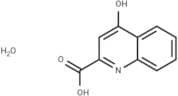
CAS 345909-35-5
:4-Hydroxychinolin-2-carbonsäure-hydrat
Beschreibung:
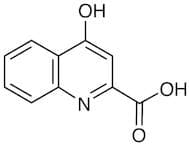
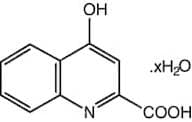
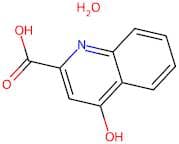
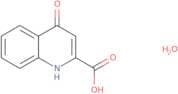
4-Hydroxychinolin-2-carbonsäure-hydrat ist eine organische Verbindung, die durch ihre Chinolinstruktur gekennzeichnet ist, die eine Hydroxylgruppe und eine Carbonsäurefunktionalgruppe aufweist. Diese Verbindung erscheint typischerweise als kristalliner Feststoff und ist bekannt für ihre potenziellen Anwendungen in der Pharmazie und Biochemie, insbesondere als Baustein in der Synthese verschiedener bioaktiver Moleküle. Die Anwesenheit der Hydroxylgruppe trägt zu ihrer Löslichkeit in polaren Lösungsmitteln bei, während die Carbonsäuregruppe an Wasserstoffbrückenbindungen und anderen Wechselwirkungen teilnehmen kann, was ihre Reaktivität erhöht. Die hydratisierte Form zeigt an, dass sie Wassermoleküle in ihrer Kristallstruktur enthält, was ihre physikalischen Eigenschaften wie Schmelzpunkt und Löslichkeit beeinflussen kann. Darüber hinaus kann 4-Hydroxychinolin-2-carbonsäure-hydrat biologische Aktivität aufweisen, was es von Interesse in der medizinischen Chemie und in der Forschung zu antimikrobiellen oder entzündungshemmenden Eigenschaften macht. Wie bei vielen organischen Verbindungen sind eine ordnungsgemäße Handhabung und Lagerung entscheidend, um ihre Stabilität und Wirksamkeit zu erhalten.
Formel:C10H6NO3
InChl:InChI=1/C10H7NO3/c12-9-5-8(10(13)14)11-7-4-2-1-3-6(7)9/h1-5H,(H,11,12)(H,13,14)/p-1
SMILES:c1ccc2c(c1)c(=O)cc(C(=O)[O-])[nH]2
Synonyme:- 4-hydroxy-Quinaldate
- 4-Hydroxyquinaldate
- 4-Hydroxyquinaldinate
- 4-Hydroxyquinoline-2-carboxylate
- Kynurenate
- 4-Oxo-1,4-Dihydroquinoline-2-Carboxylate
Sortieren nach
Reinheit (%)
0
100
|
0
|
50
|
90
|
95
|
100
6 Produkte.
Kynurenic Acid
CAS:Formel:C10H7NO3Reinheit:>98.0%(T)(HPLC)Farbe und Form:White to Gray to Brown powder to crystalMolekulargewicht:189.174-Hydroxyquinoline-2-carboxylic acid hydrate, 98%
CAS:Broad spectrum excitatory amino acid antagonist4-Hydroxyquinoline-2-carboxylic acid hydrate is used as an intermediate in synthetic chemistry. It acts as an antiexcitotoxic and anticonvulsant. It finds application in certain neurobiological disorders therapy. This Thermo Scientific Chemicals brandFormel:C10H7NO3Reinheit:98%Farbe und Form:Dark cream to cream to yellow to green to pale brown to pale gray to gray, PowderMolekulargewicht:189.174-HYDROXYQUINOLINE-2-CARBOXYLIC ACID, HYDRATE, 98
CAS:Formel:C10H9NO4Reinheit:95%Farbe und Form:SolidMolekulargewicht:207.18284-Hydroxyquinoline-2-carboxylic acid hydrate
CAS:4-Hydroxyquinoline-2-carboxylic acid hydrateFormel:C10H7NO3·H2OReinheit:≥95%Farbe und Form: faint yellow/ green solidMolekulargewicht:207.18g/mol4-Hydroxyquinoline-2-carboxylic acid hydrate
CAS:4-Hydroxyquinoline-2-carboxylic acid hydrate is a neuroprotective agent that has been shown to be effective in the treatment of neurodegenerative diseases. It is a solvate, which means that it can form crystals with water molecules and is capable of hydrogen bonding. The quinolinecarboxylic acid moiety of 4-hydroxyquinoline-2-carboxylic acid hydrate has been shown to have neuroprotective effects against neurotoxicity induced by kynurenic acid, an endogenous compound. 4-Hydroxyquinoline-2-carboxylic acid hydrate has broad spectrum activity and can be used as a broad spectrum neuroprotective agent. The molecule also displays polymorphism with tautomeric behaviour and diffraction properties.Formel:C10H7NO3·H2OReinheit:Min. 95%Molekulargewicht:189.17 g/molKynurenic Acid hydrate
CAS:Kynurenic acid, an active metabolite of tryptophan, is synthesized through a kynurenine intermediate by kynurenine aminotransferases (KATs). It acts as an antagonist of both NMDA and AMPA receptors, as well as α7 nicotinic acetylcholine receptors (nAChRs; EC50s = 235, 101, and 7 µM, respectively), and functions as an agonist for the aryl hydrocarbon receptor (AhR) and G protein-coupled receptor 35 (GPR35; EC50s = 1.4 and 39 µM, respectively). In a neonatal rat model of cerebral hypoxic-ischemia, induced by carotid artery ligation, administration of kynurenic acid at 300 mg/kg prevents weight loss in the lesioned hemisphere. Additionally, at concentrations of 1 and 5 mg/ml, it protects against neurodegeneration in the rhabdomere of the eye in an Htt93QtransgenicDrosophila model of Huntington's disease. Elevated levels of kynurenic acid in the cerebrospinal fluid have been observed in patients with schizophrenia.Formel:C10H9NO4Farbe und Form:SolidMolekulargewicht:207.185