CAS 35082-49-6
:Cercosporin
Beschreibung:
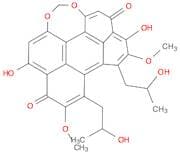
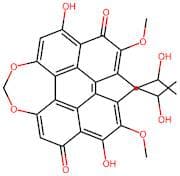
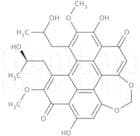
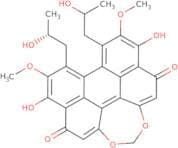
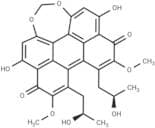
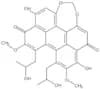
Cercosporin ist eine natürliche Verbindung, die als Polyketid klassifiziert ist und hauptsächlich von bestimmten Pilzarten, insbesondere solchen der Gattung Cercospora, produziert wird. Es ist bekannt für seine Rolle als Phytotoxin, was bedeutet, dass es schädliche Auswirkungen auf die Gesundheit von Pflanzen haben kann und oft zur Pathogenität der Pilze beiträgt, die es produzieren. Cercosporin weist eine einzigartige Struktur auf, die durch eine komplexe Anordnung von Kohlenstoff-, Wasserstoff- und Sauerstoffatomen gekennzeichnet ist, was zu seiner biologischen Aktivität beiträgt. Diese Verbindung ist bemerkenswert für ihre Fähigkeit, reaktive Sauerstoffspezies bei Lichtaktivierung zu erzeugen, was zu oxidativem Stress in Pflanzenzellen führt. Infolgedessen kann Cercosporin Symptome wie Blattflecken und Welken in infizierten Pflanzen hervorrufen. Darüber hinaus hat es Interesse im Bereich der landwirtschaftlichen Forschung geweckt, da es potenzielle Anwendungen zum Verständnis der Pflanzen-Pilz-Interaktionen und zur Entwicklung von Biokontrollstrategien bietet. Allerdings wirft seine Phytotoxizität auch Bedenken hinsichtlich seiner Auswirkungen auf die Gesundheit und den Ertrag von Nutzpflanzen auf.
Formel:C29H26O10
InChl:InChI=1S/C29H26O10/c1-10(30)5-12-18-19-13(6-11(2)31)29(37-4)27(35)21-15(33)8-17-23(25(19)21)22-16(38-9-39-17)7-14(32)20(24(18)22)26(34)28(12)36-3/h7-8,10-11,30-32,35H,5-6,9H2,1-4H3
InChI Key:InChIKey=JWFLIMIGORGZMQ-UHFFFAOYSA-N
SMILES:C(C(C)O)C=1C=2C=3C=4C5=C6C2C(CC(C)O)=C(OC)C(O)=C6C(=O)C=C5OCOC4C=C(O)C3C(=O)C1OC
Synonyme:- (+)-Cercosporin
- (13bR)-6,12-Dihydroxy-8,9-bis[(2R)-2-hydroxypropyl]-7,10-dimethoxyperylo[1,12-def]-1,3-dioxepin-5,11-dione
- 35082-49-6
- NSC 153111
- Perylo[1,12-def]-1,3-dioxepin-5,11-dione, 6,12-dihydroxy-8,9-bis(2-hydroxypropyl)-7,10-dimethoxy-, stereoisomer
- Perylo[1,12-def]-1,3-dioxepin-5,11-dione, 6,12-dihydroxy-8,9-bis[(2R)-2-hydroxypropyl]-7,10-dimethoxy-, (13bR)-
- iso-Cercosporin
- peryleno[1,12-def]-1,3-dioxepin-6,11-dione, 5,12-dihydroxy-8,9-bis[(2R)-2-hydroxypropyl]-7,10-dimethoxy-
- CGP-049090
- CERCOSPORIN FROM CERCOSPORA HAYII
- 6,12-Dihydroxy-8,9-bis(2-hydroxypropyl)-7,10-dimethoxyperylo[1,12-def]-1,3-dioxepin-5,11-dione
- 6,12-Dihydroxy-7,10-dimethoxy-8,9-bis[(R)-2-hydroxypropyl]perylo[1,12-def]-1,3-dioxepin-5,11-dione
- CGP049090, NSC 153111
- Weitere Synonyme anzeigen
Sortieren nach
Reinheit (%)
0
100
|
0
|
50
|
90
|
95
|
100
5 Produkte.
Cercosporin
CAS:CercosporinFormel:C29H26O10Reinheit:By hplc: 99.12% (Typical Value in Batch COA)Farbe und Form: red powderMolekulargewicht:534.51g/molCercosporin
CAS:Formel:C29H26O10Reinheit:(HPLC) ≥ 98.0%Farbe und Form:Dark red solidMolekulargewicht:534.51Cercosporin from Cercospora hayii
CAS:Cercosporin is a fungal metabolite that is produced by Cercospora, a genus of fungi. It is a natural compound that has been shown to have inhibitory properties against the growth of bacteria and other fungi. Cercosporin inhibits bacterial enzyme activities and has been found to be an effective treatment for some bacterial infections. The structure-activity relationship of cercosporin (CER) was studied using mutants in the polymerase chain reaction (PCR) model system, which showed that the nicotianae group of compounds are responsible for its inhibitory properties. This study also showed that cercosporin could be used as an alternative to antibiotics, which have been rendered ineffective due to their resistance to mutations.Formel:C29H26O10Reinheit:Min. 95%Farbe und Form:PowderMolekulargewicht:534.51 g/molCercosporin
CAS:Cercosporin, produced by the plant pathogen Cercospora kikuchii and the elsinochromes, is a potent photosensitizer with a short activation wavelength. Cercosporin contains perylene quinone structural features essential for PKC activity (IC50: 0.6-1.3 μM).Formel:C29H26O10Reinheit:98%Farbe und Form:SolidMolekulargewicht:534.51