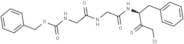
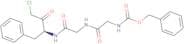
CAS 35172-59-9
:N-cbz-gly-gly-phe Chloromethylketon
Beschreibung:
N-cbz-gly-gly-phe Chloromethylketon, mit der CAS-Nummer 35172-59-9, ist eine synthetische organische Verbindung, die zur Klasse der Peptidderivate gehört. Sie weist eine Chloromethylketon-Funktionalgruppe auf, die für ihre Reaktivität, insbesondere in der Peptidsynthese und -modifikation, von Bedeutung ist. Die Bezeichnung "N-Cbz" zeigt an, dass die Aminogruppe durch eine Benzyloxycarbonyl (Cbz)-Gruppe geschützt ist, was die Stabilität und Löslichkeit der Verbindung erhöht. Das Vorhandensein von Glycin (gly) und Phenylalanin (phe) Rückständen deutet darauf hin, dass es sich um ein Dipeptidderivat handelt, das biologische Aktivitäten aufweisen kann, die für die Peptidchemie relevant sind. Diese Verbindung wird häufig in Forschungseinrichtungen verwendet, insbesondere bei der Entwicklung von peptidbasierten Arzneimitteln oder als Reagenz in der organischen Synthese. Ihre Reaktivität kann der Chloromethylketon-Gruppe zugeschrieben werden, die an nucleophilen Substitutionsreaktionen teilnehmen kann, was sie zu einem wertvollen Zwischenprodukt bei der Synthese komplexerer Moleküle macht. Angemessene Handhabungs- und Lagerbedingungen sind aufgrund ihrer reaktiven Natur unerlässlich.
Formel:C22H24ClN3O5
Synonyme:- Z-Gly-Gly-Phe-chloromethylketone
Sortieren nach
Reinheit (%)
0
100
|
0
|
50
|
90
|
95
|
100
3 Produkte.
Z-Gly-Gly-Phe-chloromethylketone
CAS:Z-GGF-CMK, a site-specific inhibitor of chymotrypsin.Formel:C22H24ClN3O5Reinheit:> 97%Farbe und Form:White PowderMolekulargewicht:445.9Z-GGF-CMK
CAS:Z-GGF-CMK, a protease inhibitor, impedes ClpP1P2 and proteasome activity and demonstrates cytotoxic effects on HepG2 cells, with a CC50 value of 125 μM [1].Formel:C22H24ClN3O5Reinheit:98%Farbe und Form:SolidMolekulargewicht:445.9Z-Gly-Gly-Phe-chloromethylketone
CAS:Glycine is a non-essential amino acid that is used in the synthesis of proteins and other biomolecules. It has three homologues: alanine, serine, and threonine. Glycine is synthesized from serine through a series of reactions that include conversion to glyoxylate by serine hydroxymethyltransferase, followed by conversion to glycolate by glyoxylate reductase and finally conversion to glycine by glyceraldehyde-3-phosphate dehydrogenase. Glycine also plays an important role in the biosynthesis of heme, collagen, erythropoietin, and various neurotransmitters. Glycine participates in the synthesis of proteins within the reticulum lumen and endoplasmic reticulum (ER) membranes. It is localized in cytoplasmic vesicles called late Golgi apparatus (LGA). The LGA are found next to theFormel:C22H24ClN3O5Reinheit:Min. 95%Molekulargewicht:445.9 g/mol