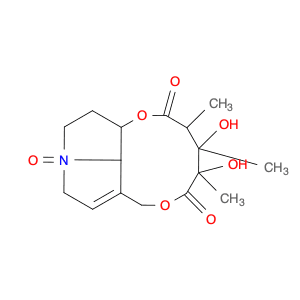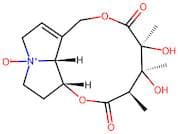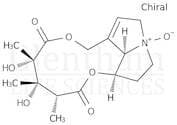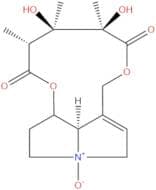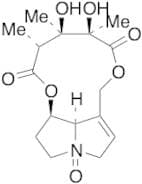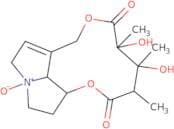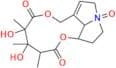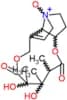
CAS 35337-98-5
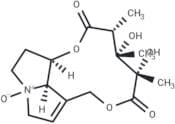
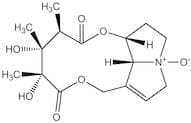
:Monocrotalin, N-oxid
- 20-Norcrotalanan-11,15-dione, 14,19-dihydro-12,13-dihydroxy-, 4-oxide, (13α,14α)-
- Monocrotaline oxide
- 2H-[1,6]Dioxacycloundecino[2,3,4-gh]pyrrolizine-2,6(3H)-dione, 4,5,8,10,12,13,13a,13b-octahydro-4,5-dihydroxy-3,4,5-trimethyl-, 11-oxide, (3R,4S,5S,13aR,13bR)-
- Monocrotaline, N-oxide
(13R,14R)-14,19-Dihydro-12,13-dihydroxy-20-norcrotalanan-11,15-dione 4-oxide
CAS:Formel:C16H23NO7Reinheit:95%Farbe und Form:SolidMolekulargewicht:341.3563Monocrotaline N-Oxide
CAS:Formel:C16H23NO7Farbe und Form:White To Off-White SolidMolekulargewicht:341.36Monocrotaline N-Oxide
CAS:Monocrotaline N-Oxide is a monocrotaline metabolite.
Formel:C16H23NO7Reinheit:98.31%Farbe und Form:SolidMolekulargewicht:341.36Monocrotaline n-oxide
CAS:Natural alkaloidFormel:C16H23NO7Reinheit:≥ 98.0 % (HPLC)Farbe und Form:PowderMolekulargewicht:341.36Monocrotaline N-Oxide
CAS:Applications Monocrotaline N-oxide is a pyrrolizidine alkaloid that is hepatoxic to livestock and carcinogenic to rats. Monocrotaline N-oxide is extracted from Crotalaria grahamiana, a legume-bearing, perennial shrub that grows in South India, and in some parts of Kenya.
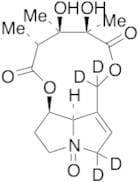
References Bünemann, E., et al.: Plant and Soil, 264, 195 (2004); Davenport, J. & Conner, W.: J. Insect Sci., 3, No pp. given (2003); Wang, J., et al.: Asian J. Trad. Med., 4, 41 (2009)Formel:C16H23NO7Reinheit:>80%Farbe und Form:NeatMolekulargewicht:341.36Monocrotaline N-Oxide-D4
CAS:Kontrolliertes ProduktApplications Monocrotaline N-oxide-D4 is a labelled analogue of Monocrotaline N-oxide (M526005). Monocrotaline N-oxide is a pyrrolizidine alkaloid that is hepatoxic to livestock and carcinogenic to rats. Monocrotaline N-oxide is extracted from Crotalaria grahamiana, a legume-bearing, perennial shrub that grows in South India, and in some parts of Kenya.
References Bünemann, E., et al.: Plant and Soil, 264, 195 (2004); Davenport, J. & Conner, W.: J. Insect Sci., 3, No pp. given (2003); Wang, J., et al.: Asian J. Trad. Med., 4, 41 (2009)Formel:C16D4H19NO7Farbe und Form:NeatMolekulargewicht:345.381Monocrotaline N-oxide
CAS:Monocrotaline N-oxide is a metabolite of monocrotaline. Monocrotaline is an alkaloid that is found in plants and has been used as a rodenticide and insecticide. The LC-MS/MS method was developed for the analysis of monocrotaline N-oxide. The method is selective, sensitive, and accurate. It has been shown to be effective in the detection of retrorsine and retronecine esters in rat liver microsomes. Monocrotaline N-oxide has been shown to have skin cancer promoting effects in rats when applied to skin at doses of 400 ppm or greater. This metabolite also has an effect on uptake by human liver cells, which may be due to its ability to form a matrix with proteins present in the cell membrane.Formel:C16H23NO7Reinheit:Min. 95%Farbe und Form:PowderMolekulargewicht:341.36 g/mol