CAS 35622-27-6
:4-Aminobutylphosphonsäure
Beschreibung:
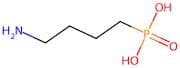
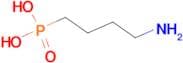
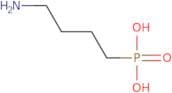
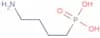
4-Aminobutylphosphonsäure, mit der CAS-Nummer 35622-27-6, ist eine organophosphorverbindung, die durch ihre Amino- und Phosphonsäurefunktionalgruppen gekennzeichnet ist. Sie weist eine vierkohlenstoffhaltige Kette auf, an der ein Aminogruppe (-NH2) am zweiten Kohlenstoff und eine Phosphonsäuregruppe (-PO3H2) an der terminalen Position angebracht ist. Diese Struktur verleiht sowohl hydrophile als auch hydrophobe Eigenschaften, wodurch sie in Wasser und polaren Lösungsmitteln löslich ist. Die Verbindung wird oft wegen ihrer potenziellen Anwendungen in der Biochemie und Pharmazie untersucht, insbesondere als Phosphonatanalog von Aminosäuren. Sie kann als Chelatbildner wirken und könnte eine Rolle in verschiedenen biologischen Prozessen spielen. Darüber hinaus kann 4-Aminobutylphosphonsäure an der Synthese anderer chemischer Verbindungen beteiligt sein und biologische Aktivität zeigen, einschließlich potenzieller neuroprotektiver Effekte. Ihre Stabilität und Reaktivität werden durch die Anwesenheit der Phosphonsäuregruppe beeinflusst, die an verschiedenen chemischen Reaktionen teilnehmen kann, einschließlich Esterifizierung und nucleophiler Substitution.
Formel:C4H12NO3P
InChl:InChI=1/C4H12NO3P/c5-3-1-2-4-9(6,7)8/h1-5H2,(H2,6,7,8)
SMILES:C(CCP(=O)(O)O)CN
Synonyme:- 4-Abpa
- Phosphonic acid, (4-aminobutyl)-
- 4-Aminobutylphosphonic acid
Sortieren nach
Reinheit (%)
0
100
|
0
|
50
|
90
|
95
|
100
4 Produkte.
4-Aminobutylphosphonic acid
CAS:Formel:C4H12NO3PReinheit:97%Farbe und Form:SolidMolekulargewicht:153.1167(4-Aminobutyl)phosphonic acid
CAS:(4-Aminobutyl)phosphonic acidReinheit:98%Molekulargewicht:153.12g/mol4-Aminobutylphosphonic acid
CAS:4-Aminobutylphosphonic acid is a potent antagonist of the ganglion cell nicotinic acetylcholine receptors. It has been shown to produce irreversible oxidation of the ganglion cell membrane by inhibiting the enzyme catalase, which is responsible for the removal of hydrogen peroxide produced by cells. 4-Aminobutylphosphonic acid also inhibits gamma-aminobutyric acid (GABA) synthesis and increases locomotor activity in frogs. This drug also binds to functional groups on the frog’s muscle cells and stimulates a nerve impulse that causes muscle contraction. The molecule has been shown to be an effective inhibitor of x-ray diffraction data from calf thymus DNA, vinyl alcohol, and glass slides.
Formel:C4H12NO3PReinheit:Min. 95%Farbe und Form:PowderMolekulargewicht:153.12 g/mol