CAS 35675-44-6
:(4-Methylphenyl)acetylchlorid
Beschreibung:
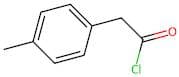
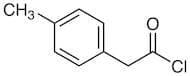
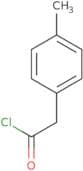
(4-Methylphenyl)acetylchlorid, auch bekannt als p-Tolylacetylchlorid, ist eine organische Verbindung, die durch das Vorhandensein einer Acetylchlorid-Funktionalgruppe gekennzeichnet ist, die an einen para-substituierten Methylphenylring gebunden ist. Seine molekulare Struktur weist einen Benzolring mit einer Methylgruppe an der para-Position relativ zur Acetylchlorid-Gruppe auf. Diese Verbindung ist typischerweise eine farblose bis blassgelbe Flüssigkeit mit einem stechenden Geruch, der auf ihre Reaktivität hinweist. Sie ist bekannt für ihre Rolle als acylierendes Mittel in der organischen Synthese, insbesondere bei der Bildung von Amiden und Estern. Das Vorhandensein der Acetylchlorid-Gruppe macht sie hochreaktiv, insbesondere gegenüber Nucleophilen, und sie kann in Gegenwart von Wasser hydrolysiert werden, wobei Salzsäure freigesetzt wird. Sicherheitsvorkehrungen sind beim Umgang mit dieser Verbindung unerlässlich, da sie ätzend und reizend für Haut, Augen und Atemwege sein kann. Eine ordnungsgemäße Lagerung an einem kühlen, trockenen Ort, fern von Feuchtigkeit, ist ebenfalls entscheidend, um ihre Stabilität zu gewährleisten und unerwünschte Reaktionen zu verhindern.
Formel:C9H9ClO
InChl:InChI=1/C9H9ClO/c1-7-2-4-8(5-3-7)6-9(10)11/h2-5H,6H2,1H3
SMILES:Cc1ccc(cc1)CC(=O)Cl
Synonyme:- Benzeneacetyl chloride, 4-methyl-
- (4-Methylphenyl)acetyl chloride
Sortieren nach
Reinheit (%)
0
100
|
0
|
50
|
90
|
95
|
100
4 Produkte.
2-(p-Tolyl)acetyl Chloride
CAS:Formel:C9H9ClOReinheit:>98.0%(GC)(T)Farbe und Form:Colorless to Light yellow clear liquidMolekulargewicht:168.62p-Tolyl-acetyl chloride
CAS:Formel:C9H9ClOReinheit:95.0%Farbe und Form:Liquid, ClearMolekulargewicht:168.62P-Tolylacetyl chloride
CAS:P-Tolylacetyl chloride is a benzyl compound that has potent cytotoxicity. It is used in the synthesis of phenylacetates, which are intermediates for the synthesis of various pharmaceuticals. P-Tolylacetyl chloride has been shown to induce apoptosis in human cancer cells, including HCT116 and other tumor cell lines. This agent also induces DNA fragmentation and inhibits protein synthesis by inhibiting translation initiation factors. P-Tolylacetyl chloride also has an antitumor effect by inhibiting tumor growth in mice with subcutaneous leukemia. It is thought that this effect may be due to its ability to inhibit the production of reactive oxygen species (ROS) and reduce levels of intracellular glutathione.Formel:C9H9ClOReinheit:Min. 95%Molekulargewicht:168.62 g/mol