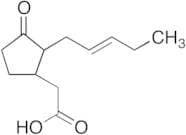
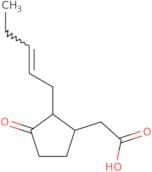
CAS 3572-66-5
:Cyclopentanessigsäure, 3-oxo-2-(2-penten-1-yl)-
Beschreibung:
Die Cyclopentanoessigsäure, 3-Oxo-2-(2-Penten-1-yl)-, mit der CAS-Nummer 3572-66-5, ist eine organische Verbindung, die durch ihre Cyclopentanringstruktur und das Vorhandensein einer Carbonsäurefunktion gekennzeichnet ist. Diese Verbindung weist eine Ketogruppe (3-Oxo) und einen alkenylierten Substituenten (2-Penten-1-yl) auf, die zu ihrer Reaktivität und potenziellen Anwendungen in der organischen Synthese beitragen. Das Vorhandensein sowohl der Carbonsäure- als auch der Ketofunktionalitäten deutet darauf hin, dass sie an verschiedenen chemischen Reaktionen teilnehmen könnte, wie z.B. Esterifizierung oder Kondensation. Derivate der Cyclopentanoessigsäure werden häufig auf ihre biologische Aktivität untersucht und können als Zwischenprodukte in der Synthese von Arzneimitteln oder Agrochemikalien dienen. Die physikalischen Eigenschaften der Verbindung, wie Löslichkeit und Siedepunkt, würden von ihrer molekularen Struktur und dem Vorhandensein funktioneller Gruppen abhängen. Insgesamt veranschaulicht diese Verbindung die Komplexität und Vielfalt organischer Moleküle, mit potenziellen Implikationen sowohl in industriellen als auch in Forschungsumgebungen.
Formel:C12H18O3
Synonyme:- Cyclopentaneaceticacid, 3-oxo-2-(2-pentenyl)- (7CI,8CI,9CI)
Sortieren nach
Reinheit (%)
0
100
|
0
|
50
|
90
|
95
|
100
3 Produkte.
(±)-Jasmonic Acid
CAS:Applications (±)-Jasmonic Acid can be used as reactant/reagent for synthetic preparation of fluorescent-labeled jasmonate and application to fluorescent imaging in cabbage seedlings.
References Liu, S., et al.: Tetrahedron Lett., 53, 4235-4239 (2012)Formel:C12H18O3Farbe und Form:NeatMolekulargewicht:210.273-Oxo-2-(2-penten-1-yl)cyclopentaneacetic acid
CAS:3-Oxo-2-(2-penten-1-yl)cyclopentaneacetic acid is a cyclopentane derivative, notable for its unique chemical structure and reactivity. This compound is typically sourced through synthetic organic chemistry techniques, often involving multistep chemical reactions starting from simpler organic molecules. Its mode of action centers around its ability to interact with specific biochemical pathways, potentially influencing various metabolic processes due to its structural mimicry of biologically active compounds.Formel:C12H18O3Reinheit:Min. 97 Area-%Farbe und Form:Clear Viscous LiquidMolekulargewicht:210.27 g/mol