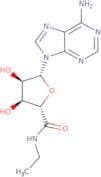
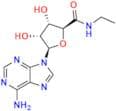
CAS 35920-39-9
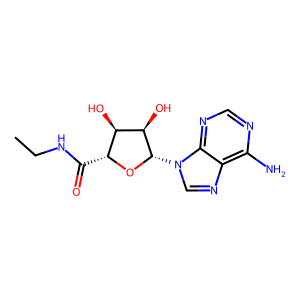
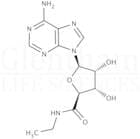
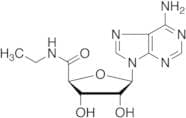
:1-(6-Amino-9H-purin-9-yl)-1-desoxy-N-ethyl-β-D-ribofuranuronamid
Beschreibung:
1-(6-Amino-9H-purin-9-yl)-1-desoxy-N-ethyl-β-D-ribofuranuronamid, mit der CAS-Nummer 35920-39-9, ist ein Purinderivat, das typische Eigenschaften von Nukleosiden aufweist. Diese Verbindung weist eine Purinbase, speziell Adenin, auf, die an ein Ribofuranose-Zucker-Moiety gebunden ist, das durch die Anwesenheit einer Ethylgruppe an der Stickstoffposition modifiziert ist. Die Aminogruppe an der 6-Position des Purinrings trägt zu seiner potenziellen biologischen Aktivität bei, möglicherweise indem sie die Wechselwirkungen mit Nukleinsäurestrukturen oder Enzymen beeinflusst. Die Anwesenheit der Desoxygruppe zeigt an, dass es an der 2'-Position des Riboses ein Sauerstoffatom fehlt, was für seine Stabilität und Reaktivität von Bedeutung ist. Diese Verbindung könnte von Interesse in der biochemischen Forschung sein, insbesondere in Studien, die sich mit dem Metabolismus von Nukleinsäuren, antiviraler Aktivität oder als potenzielles Therapeutikum befassen. Ihre Löslichkeit, Stabilität und Reaktivität würden von den spezifischen Bedingungen der Umgebung abhängen, wie pH und Temperatur, sowie von der Anwesenheit anderer chemischer Spezies.
Formel:C12H16N6O4
InChl:InChI=1S/C12H16N6O4/c1-2-14-11(21)8-6(19)7(20)12(22-8)18-4-17-5-9(13)15-3-16-10(5)18/h3-4,6-8,12,19-20H,2H2,1H3,(H,14,21)(H2,13,15,16)/t6-,7+,8-,12+/m0/s1
InChI Key:InChIKey=JADDQZYHOWSFJD-FLNNQWSLSA-N
SMILES:O[C@H]1[C@H](N2C=3C(N=C2)=C(N)N=CN3)O[C@H](C(NCC)=O)[C@H]1O
Synonyme:- (2S,3R,5R)-5-(6-amino-9H-purin-9-yl)-N-ethyl-3,4-dihydroxytetrahydrofuran-2-carboxamide (non-preferred name)
- (2S,3S,4R)-5-(6-amino-9H-purin-9-yl)-N-ethyl-3,4-dihydroxytetrahydrofuran-2-carboxamide (non-preferred name)
- (2S,3S,4R,5R)-5-(6-amino-9H-purin-9-yl)-N-ethyl-3,4-dihydroxytetrahydrofuran-2-carboxamide (non-preferred name)
- 1-(6-Amino-9H-purin-9-yl)-1-deoxy-N-ethyl-beta-D-ribofuranuronamide
- 1-(6-Amino-9H-purin-9-yl)-1-deoxy-N-ethyl-β-<span class="text-smallcaps">D</span>-ribofuranuronamide
- 5'-N(Sup 6)-Ethylcarboxamidoadenosine
- 5'-N-Ethylcarboxamidoadenosine
- 5′-N<sup>6</sup>-Ethylcarboxamidoadenosine
- 744-96
- Adenosine 5′-ethylcarboxamide
- Adenosine-5'-(N-ethylcarboxamide)
- D-Neca
- beta-D-Ribofuranuronamide, 1-(6-amino-9H-purin-9-yl)-1-deoxy-N-ethyl-
- β-<span class="text-smallcaps">D</span>-Ribofuranuronamide, 1-(6-amino-9H-purin-9-yl)-1-deoxy-N-ethyl-
- β-D-Ribofuranuronamide, 1-(6-amino-9H-purin-9-yl)-1-deoxy-N-ethyl-
- Weitere Synonyme anzeigen
Sortieren nach
Reinheit (%)
0
100
|
0
|
50
|
90
|
95
|
100
6 Produkte.
5'-N-Ethylcarboxamidoadenosine
CAS:5'-N-EthylcarboxamidoadenosineReinheit:≥95%Molekulargewicht:308.29g/mol5'-N-Ethylcarboxamidoadenosine
CAS:NECA, an adenosine receptor agonist, boosts brain extravasation of fluorescein and dextran without affecting the blood-brain barrier.Formel:C12H16N6O4Reinheit:98.95% - ≥95%Farbe und Form:PowderMolekulargewicht:308.295’-Ethylcarboxamido Adenosine
CAS:Kontrolliertes ProduktStability Hygroscopic
Applications A potent adenosine receptor agonist. Inhibits platelet aggregation and is centrally active in vivo.
Not a dangerous good if item is equal to or less than 1g/ml and there is less than 100g/ml in the package
References Cusack and Hourani: Br. J. Pharmacol., 72, 433 (1981), Knapp, et al.: Pharmacol. Biochem. Behav., 68, 797 (2001)Formel:C12H16N6O4Farbe und Form:NeatMolekulargewicht:308.295'-Ethylcarboxamidoadenosine
CAS:5'-Ethylcarboxamidoadenosine (5-ECA) is an adenosine receptor antagonist that is used as a radioligand to study the binding of adenosine and other nucleotides to their receptors. 5-ECA binds to the A3 receptor, which is a member of the G protein-coupled receptor family. This compound also inhibits platelet aggregation and has been shown to have anti-inflammatory effects in mice with colon cancer. 5-ECA was found to inhibit tumor growth in a mouse model system by suppressing IL-2 production and reducing levels of PGE2, an effect that may be due to inhibition of cyclase activity. 5-ECA can be used in vitro for studies on pluripotent cells because it does not affect their ability to differentiate.Formel:C12H16N6O4Reinheit:Min. 95%Farbe und Form:White PowderMolekulargewicht:308.29 g/mol