CAS 3594-37-4
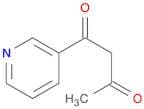
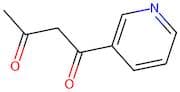
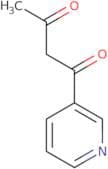
:1-(3-Pyridinyl)-1,3-butanedion
Beschreibung:
1-(3-Pyridinyl)-1,3-butanedion, auch bekannt als 3-Pyridin-1,3-butanedion, ist eine organische Verbindung, die durch ihren Pyridinring und eine Diketongruppe gekennzeichnet ist. Sie weist ein Butanedion-Rückgrat mit einem Pyridinsubstituenten an einem Ende auf, was zu ihren einzigartigen chemischen Eigenschaften beiträgt. Diese Verbindung erscheint typischerweise als gelbes bis braunes Feststoff oder Flüssigkeit, abhängig von ihrer Reinheit und Form. Sie ist in organischen Lösungsmitteln wie Ethanol und Aceton löslich, hat jedoch eine begrenzte Löslichkeit in Wasser aufgrund ihrer hydrophoben Natur. Die Anwesenheit des Pyridinrings verleiht Basizität und Potenzial zur Koordination mit Metallionen, was sie in der Koordinationschemie und Katalyse von Interesse macht. Darüber hinaus ermöglicht ihre Diketonstruktur verschiedene chemische Reaktionen, einschließlich Kondensation und Oxidation. 1-(3-Pyridinyl)-1,3-butanedion kann auch biologische Aktivität zeigen, die für potenzielle Anwendungen in der Pharmazie oder Agrochemie untersucht werden könnte. Wie bei vielen organischen Verbindungen sollte der Umgang mit Vorsicht erfolgen, wobei Sicherheitsdaten und potenzielle Gefahren zu berücksichtigen sind.
Formel:C9H9NO2
InChl:InChI=1S/C9H9NO2/c1-7(11)5-9(12)8-3-2-4-10-6-8/h2-4,6H,5H2,1H3
InChI Key:InChIKey=OVPXWZQQDUKDFN-UHFFFAOYSA-N
SMILES:C(CC(C)=O)(=O)C=1C=CC=NC1
Synonyme:- 1,3-Butanedione, 1- (3-pyridinyl)-
- 1,3-Butanedione, 1- (3-pyridyl)-
- 1-(3-Pyridinyl)-1,3-butanedione
- 1-(3-Pyridyl)-1,3-butanedione
- 1-Nicotinoylacetone
- NSC 174282
- Nicotinoylacetone
Sortieren nach
Reinheit (%)
0
100
|
0
|
50
|
90
|
95
|
100
4 Produkte.
1-(Pyridin-3-yl)butane-1,3-dione
CAS:1-(Pyridin-3-yl)butane-1,3-dioneReinheit:95%Molekulargewicht:163.18g/molRef: 10-F216517
1g785,00€5g3.460,00€10g5.751,00€2.5g1.803,00€50mg228,00€100mg291,00€250mg401,00€500mg624,00€1-(Pyridin-3-yl)butane-1,3-dione
CAS:1-(Pyridin-3-yl)butane-1,3-dione is an activating agent that can be used to treat a variety of disorders. It activates the insulin receptor and has been shown to activate the PPAR alpha and gamma heterodimers in vitro. 1-(Pyridin-3-yl)butane-1,3-dione may also have a proliferating effect on cells. This compound is a chelate ring that contains heterocyclic bonds, which are often found in compounds with profiles similar to those of 1-(pyridin-3-yl)butane-1,3-dione. The structural formula for this compound is shown below:
Formel:C9H9NO2Reinheit:Min. 95%Molekulargewicht:163.17 g/mol