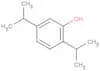
CAS 35946-91-9
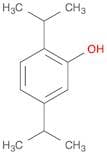
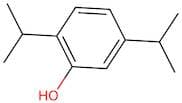
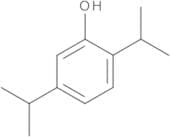
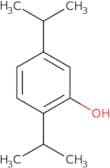
:2,5-Diisopropylphenol
Beschreibung:
2,5-Diisopropylphenol ist eine organische Verbindung, die durch ihre phenolische Struktur gekennzeichnet ist und zwei Isopropylgruppen an den Positionen 2 und 5 des Benzolrings aufweist. Diese Verbindung ist typischerweise eine farblose bis blassgelbe Flüssigkeit mit einem charakteristischen Geruch. Sie ist in organischen Lösungsmitteln löslich, hat jedoch eine begrenzte Löslichkeit in Wasser aufgrund ihrer hydrophoben Isopropylgruppen. Die Anwesenheit der Hydroxylgruppe (-OH) verleiht einige polare Eigenschaften, die potenzielle Wasserstoffbrückenbindungen ermöglichen. 2,5-Diisopropylphenol ist bekannt für seine antioxidativen Eigenschaften und wird häufig in verschiedenen industriellen Anwendungen eingesetzt, unter anderem als Stabilisator in Kunststoffen und als Zwischenprodukt bei der Synthese anderer chemischer Verbindungen. Seine chemische Stabilität und Reaktivität können durch die sterische Hinderung, die durch die Isopropylgruppen bereitgestellt wird, beeinflusst werden, was seine Wechselwirkungen in verschiedenen chemischen Umgebungen beeinflussen kann. Sicherheitsdaten sollten für Handhabungs- und Expositionsrichtlinien konsultiert werden, wie bei jeder chemischen Substanz.
Formel:C12H18O
InChl:InChI=1/C12H18O/c1-8(2)10-5-6-11(9(3)4)12(13)7-10/h5-9,13H,1-4H3
InChI Key:InChIKey=VFNUNYPYULIJSN-UHFFFAOYSA-N
SMILES:C(C)(C)C1=CC(O)=C(C(C)C)C=C1
Synonyme:- 2,5-Bis(1-methylethyl)phenol
- 2,5-Bis(propan-2-yl)phenol
- 2,5-Di(Propan-2-Yl)Phenol
- Phenol, 2,5-bis(1-methylethyl)-
- Phenol, 2,5-diisopropyl-
- 2,5-Diisopropylphenol
- Propofol Impurity 4(Propofol EP Impurity D)
- Propofol impurity D
- p-Diisopropylbenzene monoalc.
- CPD2034
- Einecs 252-807-4
- Weitere Synonyme anzeigen
Sortieren nach
Reinheit (%)
0
100
|
0
|
50
|
90
|
95
|
100
7 Produkte.
2,5-bis(propan-2-yl)phenol
CAS:Formel:C12H18OReinheit:95%Farbe und Form:SolidMolekulargewicht:178.27072,5-Diisopropylphenol
CAS:2,5-Diisopropylphenol is a phenolic compound that belongs to the group of antioxidants. It is an effective scavenger and inhibitor of lipid peroxidation. 2,5-Diisopropylphenol also inhibits nitro and hydroxy radicals, which are reactive oxygen species (ROS) that can cause membrane lipid peroxidation and other oxidative damage. This compound has been shown to have a protective effect on the liver by reducing the toxicity of some drugs. In addition, it has antibacterial activity against Gram-positive bacteria. 2,5-Diisopropylphenol's antioxidant properties are due to its ability to interact with phosphatidylcholine and prevent its oxidation by ROS. It is also glucuronidated in humans and rats.Formel:C12H18OReinheit:Min. 95%Molekulargewicht:178.27 g/mol