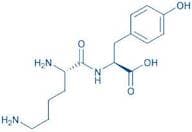
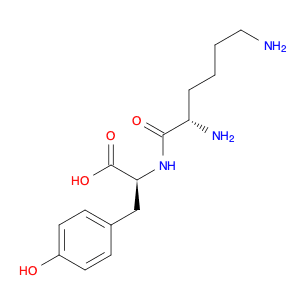
CAS 35978-98-4
:L-Tyrosin, L-lysinyl-
Beschreibung:
L-Tyrosin, L-lysinyl- ist ein Dipeptid, das aus den Aminosäuren L-Tyrosin und L-Lysin gebildet wird. Es zeichnet sich durch seine Rolle bei der Proteinsynthese und seine Beteiligung an verschiedenen Stoffwechselprozessen aus. L-Tyrosin ist eine nicht essentielle Aminosäure, die als Vorläufer für Neurotransmitter wie Dopamin, Noradrenalin und Adrenalin dient, während L-Lysin eine essentielle Aminosäure ist, die wichtig für die Proteinsynthese, die Hormonproduktion und die Calciumaufnahme ist. Die Kombination dieser beiden Aminosäuren in L-Tyrosin, L-lysinyl- kann die Bioverfügbarkeit und Funktionalität der einzelnen Aminosäuren verbessern. Diese Verbindung ist typischerweise in Wasser löslich und kann spezifische biologische Aktivitäten aufweisen, einschließlich potenzieller antioxidativer Eigenschaften. Sie wird häufig im Kontext von Nahrungsergänzungsmitteln und therapeutischen Anwendungen untersucht, insbesondere hinsichtlich ihrer potenziellen Auswirkungen auf die Stimmung, die kognitive Funktion und die allgemeine Gesundheit. Wie bei vielen Peptiden können Stabilität und Aktivität durch Faktoren wie pH, Temperatur und das Vorhandensein anderer Verbindungen beeinflusst werden.
Formel:C15H23N3O4
Synonyme:- L-Tyrosine,N-L-lysyl-
- Tyrosine, N-lysyl- (6CI,7CI)
- 125: PN: WO2010017468 SEQID: 125unclaimed protein
- 34: PN: WO2009143133 PAGE: 61 claimed protein
- 6: PN:JP2007217358 SEQID: 6 claimed protein
- L-Lysyl-L-tyrosine
- Lysyltyrosine
Sortieren nach
Reinheit (%)
0
100
|
0
|
50
|
90
|
95
|
100
3 Produkte.
H-Lys-Tyr-OH
CAS:Both single-dose administration and repetitive oral application of the dipeptide KY significantly decreased blood pressure in spontaneously hypertensive rats.Formel:C15H23N3O4Reinheit:> 99%Farbe und Form:White PowderMolekulargewicht:309.37H-Lys-Tyr-OH acetate salt
CAS:H-Lys-Tyr-OH acetate salt (HAT) is a synthetic nonsteroidal anti-inflammatory drug that has been used in the treatment of inflammatory diseases and cancer. HAT is an optical isomer of the naturally occurring amino acid L-lysine. It has been shown to have antioxidative properties and to be active against HIV infection and inflammatory diseases, including diabetes. HAT also has a molecular structure that makes it a potential therapeutic agent for cancer, as well as for women with osteoporosis and other chronic inflammatory conditions.Formel:C15H23N3O4Reinheit:Min. 95%Molekulargewicht:309.36 g/mol