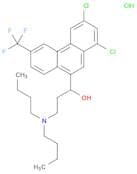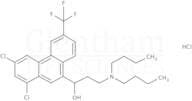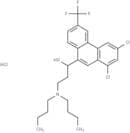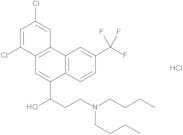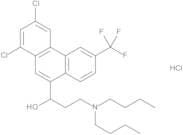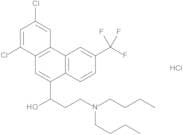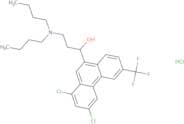
CAS 36167-63-2
:(±)-Halofantrin-Hydrochlorid
Beschreibung:
(±)-Halofantrin-Hydrochlorid ist ein synthetisches Antimalariamittel, das hauptsächlich zur Behandlung von Malaria verursacht durch Plasmodium falciparum eingesetzt wird. Es zeichnet sich durch seine komplexe chemische Struktur aus, die ein Phenanthren-Rückgrat und eine Piperidin-Gruppe umfasst. Die Substanz wird typischerweise als Hydrochlorid-Salz präsentiert, was ihre Löslichkeit in wässrigen Lösungen erhöht. Halofantrin zeigt einen Wirkmechanismus, der eine Beeinträchtigung des Häm-Entgiftungsprozesses im Malariaparasiten beinhaltet, was zur Ansammlung von toxischem Häm führt und letztendlich den Parasiten tötet. Die Verbindung ist bekannt für ihre relativ hohe Lipophilie, die ihre Pharmakokinetik beeinflusst, einschließlich Absorption und Verteilung im Körper. Es ist jedoch wichtig zu beachten, dass (±)-Halofantrin signifikante Nebenwirkungen haben kann, einschließlich Kardiotoxizität, was eine sorgfältige Überwachung während der Behandlung erforderlich macht. Die Verbindung wird in die Kategorie der Antimalariamittel eingeordnet und unterliegt regulatorischen Kontrollen aufgrund ihres Potenzials für unerwünschte Wirkungen und Wechselwirkungen mit anderen Medikamenten.
Formel:C26H30Cl2F3NO·ClH
InChl:InChI=1S/C26H30Cl2F3NO.ClH/c1-3-5-10-32(11-6-4-2)12-9-25(33)23-16-22-21(14-18(27)15-24(22)28)20-13-17(26(29,30)31)7-8-19(20)23;/h7-8,13-16,25,33H,3-6,9-12H2,1-2H3;1H
InChI Key:InChIKey=WANGFTDWOFGECH-UHFFFAOYSA-N
SMILES:C(CCN(CCCC)CCCC)(O)C1=C2C(=C3C(=C1)C(Cl)=CC(Cl)=C3)C=C(C(F)(F)F)C=C2.Cl
Synonyme:- (Dibutylamino)Ethyl)-6-(Trifluoromethyl)-9-Phenanthrenemethanol Hydrochloride
- 1,3-Dichloro-6-trifluoromethyl-9-(3-(dibutylamino)-1-hydroxypropyl)phenanthrene HCl
- 1,3-Dichloro-alpha-(2-(dibutylamino)ethyl)-6-(trifluoromethyl)phenanthren-1-methanol hydrochloride
- 1,3-Dichloro-alpha-(2-1,3-dichloro-α-[2-(dibutylamino)ethyl]-6-(trifluoromethyl)phenanthren-1-methanol hydrochloride
- 1-(1,3-Dichloro-6-trifluoromethyl-9-phenanthryl)-3-(di-n-butylamino)propanol hydrochloride
- 3-(Dibutylamino)-1-[1,3-Dichloro-6-(Trifluoromethyl)Phenanthren-9-Yl]Propan-1-Ol Hydrochloride (1:1)
- 9-(3-(Dibutylamino)-1-Hydroxypropyl)-1,3-Dichloro-6-(Trifluoromethyl)Phenanthrene Hydrochloride
- 9-Phenanthrenemethanol, 1,3-dichloro-alpha-(2-(dibutylamino)ethyl)-6-(trifluoromethyl)-, hydrochloride
- 9-Phenanthrenemethanol, 1,3-dichloro-α-[2-(dibutylamino)ethyl]-6-(trifluoromethyl)-, hydrochloride
- 9-Phenanthrenemethanol, 1,3-dichloro-α-[2-(dibutylamino)ethyl]-6-(trifluoromethyl)-, hydrochloride (1:1)
- Halofantrine Hcl
- Halofantrine Hydrochloride [USAN]
- Halofantrino
- Halofantrino [Spanish]
- Skf 102886
- Unii-H77Dl0Y630
- Wr 171669
- (+-)-Halofantrine hydrochloride
- Weitere Synonyme anzeigen
Sortieren nach
Reinheit (%)
0
100
|
0
|
50
|
90
|
95
|
100
9 Produkte.
HALOFANTRINE HYDROCHLORIDE CRS
CAS:HALOFANTRINE HYDROCHLORIDE CRSFormel:C26H31Cl3F3NOFarbe und Form:White. Powder.Molekulargewicht:536.8846Halofantrine hydrochloride
CAS:Formel:C26H31Cl3F3NOReinheit:98%Farbe und Form:SolidMolekulargewicht:536.8846Halofantrine hydrochloride
CAS:Halofantrine hydrochloride (SKF-102886) is an orally administered antimalarial drug effective against drug-resistant P. falciparum and P. vivax. SKF-102886 has cardiac toxicity, inhibiting hERG and delayed rectifier potassium channel I Kr, leading to prolonged QTc and PR intervals.Formel:C26H31Cl3F3NOReinheit:98%Farbe und Form:SolidMolekulargewicht:536.89Halofantrine Hydrochloride
CAS:Kontrolliertes ProduktFormel:C26H30Cl2F3NO·ClHFarbe und Form:NeatMolekulargewicht:536.88Halofantrine Hydrochloride
CAS:Kontrolliertes ProduktApplications Antimalarial.
References Schmidt, L.H., et al.: Antimicrob. Agents Chemother., 14, 292 (1978), Hines, J.W., et al.: J. Pharm. Sci., 74, 433 (1985), Bryson, H.M., et al.: Drugs, 43, 236 (1992),Formel:C26H30Cl2F3NO·ClHFarbe und Form:NeatMolekulargewicht:536.88Halofantrine hydrochloride
CAS:Halofantrine is a drug that belongs to the class of antimalarial drugs. It has been shown to be effective against the malaria parasite in vivo and in vitro. Halofantrine has been shown to have toxic effects on the skin, liver, and kidneys by inhibiting certain enzyme activities. This drug also causes autoimmune diseases and infectious diseases as well as cardiac effects, metabolic disorders, and serum prolactin levels. Halofantrine may have an effect on drug interactions with other medications. Halofantrine also causes a decrease in blood pressure due to its ability to reduce heart rate.Formel:C26H31Cl3F3NOReinheit:Min. 95%Molekulargewicht:536.88 g/mol