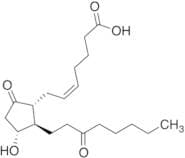
CAS 363-23-5
:13,14-Dihydro-15-keto-PGE2
Beschreibung:
13,14-Dihydro-15-keto-PGE2, mit der CAS-Nummer 363-23-5, ist ein Derivat der Prostaglandine, das eine Rolle in verschiedenen physiologischen Prozessen spielt. Diese Verbindung ist durch ihre strukturellen Modifikationen gekennzeichnet, einschließlich der Reduktion der Doppelbindung zwischen den Kohlenstoffen 13 und 14 und der Anwesenheit einer Keto-Gruppe am Kohlenstoff 15. Diese Modifikationen beeinflussen ihre biologische Aktivität und Rezeptorinteraktionen. Prostaglandine, einschließlich dieses spezifischen Derivats, sind bekannt für ihre Beteiligung an Entzündungen, Schmerzmodulation und der Regulierung verschiedener Körperfunktionen wie Blutfluss und Kontraktion der glatten Muskulatur. 13,14-Dihydro-15-keto-PGE2 wird typischerweise im Kontext seiner pharmakologischen Wirkungen und potenziellen therapeutischen Anwendungen untersucht. Seine Stabilität, Löslichkeit und Reaktivität können je nach Umweltbedingungen variieren, was es wichtig macht, diese Verbindung in Laborumgebungen mit Vorsicht zu behandeln. Insgesamt ist diese Substanz in der Biochemie und Pharmakologie von Bedeutung und trägt zu unserem Verständnis der Biologie der Prostaglandine und ihrer Implikationen für Gesundheit und Krankheit bei.
Formel:C20H32O5
InChl:InChI=1S/C20H32O5/c1-2-3-6-9-15(21)12-13-17-16(18(22)14-19(17)23)10-7-4-5-8-11-20(24)25/h4,7,16-17,19,23H,2-3,5-6,8-14H2,1H3,(H,24,25)/b7-4-/t16-,17-,19-/m1/s1
InChI Key:InChIKey=CUJMXIQZWPZMNQ-XYYGWQPLSA-N
SMILES:C(/C=C\CCCC(O)=O)[C@@H]1[C@@H](CCC(CCCCC)=O)[C@H](O)CC1=O
Synonyme:- (5Z,11alpha)-11-hydroxy-9,15-dioxoprost-5-en-1-oic acid
- (5Z,11α)-11-Hydroxy-9,15-dioxoprost-5-en-1-oic acid
- 11-Hydroxy-9,15-Dioxoprost-5-En-1-Oic Acid
- 11α-Hydroxy-9,15-diketoprost-5-enoic acid
- 11α-Hydroxy-9,15-dioxoprost-5-enoic acid
- 13,14-Dihydro-15-dehydro-PGE<sub>2</sub>
- 13,14-Dihydro-15-keto-PGE2
- 13,14-Dihydro-15-keto-PGE<sub>2</sub>
- 13,14-Dihydro-15-keto-PGE<sub>2</sub>(I)
- 13,14-Dihydro-15-ketoprostaglandin E<sub>2</sub>
- 13,14-Dihydro-15-oxo-PGE<sub>2</sub>
- 13,14-Dihydro-15-oxoprostaglandin E<sub>2</sub>
- 15-Keto-13,14-dihydro-PGE2
- 15-Keto-13,14-dihydroprostaglandin E2
- 15-Oxo-13,14-dihydro-PGE<sub>2</sub>
- 15-Oxo-13,14-dihydroprostaglandin E<sub>2</sub>
- 5-Heptenoic acid, 7-[3-hydroxy-5-oxo-2-(3-oxooctyl)cyclopentyl]-
- DKE<sub>2</sub>
- DhkPGE<sub>2</sub>
- Kh(2)Pge(2)
- Pgem
- Prost-5-en-1-oic acid, 11-hydroxy-9,15-dioxo-, (5Z,11alpha)-
- Prost-5-en-1-oic acid, 11-hydroxy-9,15-dioxo-, (5Z,11α)-
- Prostaglandin EM
- Weitere Synonyme anzeigen
Sortieren nach
Der Reinheitsfilter ist nicht sichtbar, weil die aktuellen Produkte keine zugeordneten Reinheitsdaten für die Filterung besitzen.
2 Produkte.
13,14-Dihydro-15-ketoPGE2
CAS:Kontrolliertes ProduktFormel:C20H32O5Farbe und Form:NeatMolekulargewicht:352.46513,14-dihydro-15-keto Prostaglandin E2
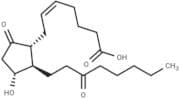
CAS:13,14-dihydro-15-keto Prostaglandin E2 (13,14-dihydro-15-keto PGE2) serves as the predominant metabolite of PGE2 in plasma, created through a 15-keto PGE2 intermediate by the action of 15-oxo-PG Δ13 reductase. Unlike its precursor PGE2, this compound exhibits poor binding affinity towards EP2 and EP4 PGE2 receptors (Ki values of 12 and 57 µM, respectively) in CHO cells and fails to stimulate adenylate cyclase activity therein (EC50s >18 and >38 µM, respectively). Concentrations of 13,14-dihydro-15-keto PGE2 are notably higher in the plasma of pregnant women during their third trimester and at labor and delivery stages, whereas its levels are found to be reduced in the tumor tissues of patients with non-small cell lung cancer (NSCLC) compared to adjacent healthy tissue.Formel:C20H32O5Farbe und Form:SolidMolekulargewicht:352.5