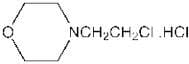
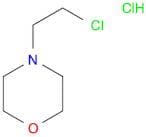
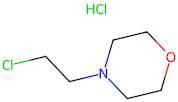
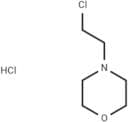
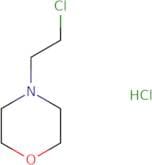
CAS 3647-69-6
:4-(2-Chlorethyl)morpholinhydrochlorid
- 1-(Morpholin-4-yl)-2-chloroethane hydrochloride
- 1-Chloro-2-(morpholin-4-yl)ethane monohydrochloride
- 1-Chloro-2-morpholinoethane hydrochloride
- 2-(4-Morpholinyl)ethyl chloride hydrochloride
- 2-(N-Morpholino)ethyl chloride hydrochloride
- 2-Morpholinoethyl chloride hydrochloride
- 4-(2-Chloroethyl)Mopholine Hydrochloride
- 4-(2-Chloroethyl)Morpholin-4-Ium
- 4-(2-Chloroethyl)Morpholine Hydrochloride
- 4-(2-Chloroethyl)Morpholine Hydrochloride (1:1)
- 4-(2-Chloroethyl)morpholine monohydrochloride
- 4-(2-Chloroethyl)morpholinium chloride
- Morpholine, 4-(2-chloroethyl)-, hydrochloride
- Morpholine, 4-(2-chloroethyl)-, hydrochloride (1:1)
- Morpholinoethyl chloride hydrochloride
- N-(2-Chloroethyl) morpholine HCl
- N-(β-Chloroethyl)morpholine hydrochloride
- β-Morpholinoethyl chloride hydrochloride
- N-(2-Chloroethyl)morpholine hydrochloride
- 1-Chloro-2-morpholinoethanehydrochloride
- MOCPRF
- N-(2-Chloroethyl)morpholineHCl,[2-(N-Morpholino)ethylchlorideHCL]
- 2-ChloroethylmorpholineHcl98%
- 4-(2-chloroethyl)-morpholinhydrochloride
- N-(2-CHLORETHYL)-MORPHOLINIUM CHLORIDE
- N-morpholinoethylchloride hydrochloride
- N-(2-Chloroethyl)morpholine hydrochloride 99%
- 2-CHLOROETHYLMORPHOLINE HYDROCHLORIDE
- 2-Chloroethylmorpholine Hcl 98%
- Weitere Synonyme anzeigen
4-(2-Chloroethyl)morpholine Hydrochloride
CAS:Formel:C6H12ClNO·HClReinheit:>97.0%(T)Farbe und Form:White to Almost white powder to crystalineMolekulargewicht:186.084-(2-Chloroethyl)morpholine hydrochloride, 99%
CAS:4-(2-Chloroethyl)morpholine hydrochloride (MOC) is used as intermediate for the synthesis of pharmaceuticals (e.g. floredil, morinamide, nimorazole and pholcodine). It is also used as Agrochemical Intermediates, dyestuff Intermediates. This Thermo Scientific Chemicals brand product was originally paFormel:C6H13Cl2NOReinheit:99%Farbe und Form:White to cream, Crystals or powder or hygroscopic crystalline powderMolekulargewicht:186.084-(2-Chloroethyl)morpholine hydrochloride
CAS:Formel:C6H13Cl2NOReinheit:95%Farbe und Form:SolidMolekulargewicht:186.07954-(2-Chloroethyl)morpholine hydrochloride
CAS:4-(2-Chloroethyl)morpholine hydrochlorideFormel:C6H12ClNO·ClHReinheit:99%Farbe und Form: white to off white crystalline solidMolekulargewicht:186.08g/mol4-(2-Chloroethyl)morpholine hydrochloride
CAS:Formel:C6H12ClNO·HClReinheit:98.0 - 102.0 %Farbe und Form:White to light-beige crystalline powder or crystalsMolekulargewicht:186.084-(2-Chloroethyl)morpholine Hydrochloride
CAS:Applications 4-(2-Chloroethyl)morpholine is used in the preparation of potential DNA cross-linking antitumor agents as well as synthetic opiate analogues. 4-(2-Chloroethyl)morpholine may possess sickle-cell hemoglobin aggregation inhibiting-activity.
Not a dangerous good if item is equal to or less than 1g/ml and there is less than 100g/ml in the package
References Anderson, F.M. et al.: Anti-Cancer Drug Des., 15, 119 (2000); Stubbins, J.F. et al.: Eur. J. med. Chem., 14, 219 (1979);Formel:C6H12ClNO·HClFarbe und Form:NeatMolekulargewicht:186.084-(2-Chloroethyl)morpholine hydrochloride
CAS:Formel:C6H13Cl2NOReinheit:95%Farbe und Form:SolidMolekulargewicht:186.084-(2-Chloroethyl)morpholine hydrochloride
CAS:4-(2-Chloroethyl)morpholine hydrochloride is a useful organic compound for research related to life sciences. The catalog number is T65948 and the CAS number is 3647-69-6.Formel:C6H13Cl2NOFarbe und Form:SolidMolekulargewicht:186.084-(2-Chloroethyl)morpholine hydrochloride
CAS:4-(2-Chloroethyl)morpholine hydrochloride (PCEM) is a potent and selective inhibitor of bacterial topoisomerase IV. The compound has been found to have no effect on the mammalian enzyme, but does inhibit growth in bacteria such as Staphylococcus aureus and Escherichia coli. PCEM exhibits good stability in organic solvents, including water, and is not toxic to mammals at high doses. The compound has been used as an antibacterial agent in pharmaceutical preparations.
Formel:C6H12ClNO•HClFarbe und Form:PowderMolekulargewicht:186.08 g/mol