CAS 36640-41-2
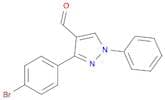
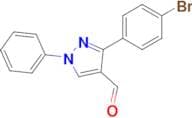
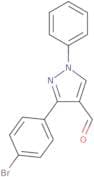
:3-(4-bromphenyl)-1-phenyl-1H-pyrazol-4-carbaldehyd
Beschreibung:
3-(4-bromphenyl)-1-phenyl-1H-pyrazol-4-carbaldehyd ist eine organische Verbindung, die durch ihren Pyrazol-Kern gekennzeichnet ist, der ein fünfgliedriger Ring mit zwei Stickstoffatomen ist. Diese Verbindung weist eine Phenylgruppe und ein Bromphenylsubstituent auf, was zu ihren aromatischen Eigenschaften und potenziellen Reaktivität beiträgt. Das Vorhandensein der Aldehydfunktion (-CHO) an der 4-Position des Pyrazolrings deutet darauf hin, dass sie an verschiedenen chemischen Reaktionen teilnehmen kann, wie z.B. nucleophile Addition oder Kondensationsreaktionen. Das Bromatom in der para-Position des Phenylrings erhöht die Elektrophilie der Verbindung und kann ihre biologische Aktivität beeinflussen. Diese Verbindung ist von Interesse in der medizinischen Chemie und Materialwissenschaft aufgrund ihrer potenziellen Anwendungen in der Arzneimittelentwicklung und als Baustein für komplexere Moleküle. Ihre Löslichkeit und Stabilität können je nach Lösungsmittel und Bedingungen variieren, was es wichtig macht, diese Faktoren in praktischen Anwendungen zu berücksichtigen. Insgesamt veranschaulicht diese Verbindung die vielfältige Chemie, die mit substituierten Pyrazolen verbunden ist.
Formel:C16H11BrN2O
InChl:InChI=1/C16H11BrN2O/c17-14-8-6-12(7-9-14)16-13(11-20)10-19(18-16)15-4-2-1-3-5-15/h1-11H
SMILES:c1ccc(cc1)n1cc(C=O)c(c2ccc(cc2)Br)n1
Synonyme:- 1H-Pyrazole-4-carboxaldehyde, 3-(4-bromophenyl)-1-phenyl-
- 3-(4-Bromo-phenyl)-1-phenyl-1H-pyrazole-4-carbaldehyde
- 3-(4-Bromophenyl)-1-phenyl-1H-pyrazole-4-carbaldehyde
Sortieren nach
Reinheit (%)
0
100
|
0
|
50
|
90
|
95
|
100
3 Produkte.
1H-Pyrazole-4-carboxaldehyde,3-(4-bromophenyl)-1-phenyl-
CAS:Formel:C16H11BrN2OReinheit:95%Molekulargewicht:327.17533-(4-Bromophenyl)-1-phenyl-1H-pyrazole-4-carboxaldehyde
CAS:Reinheit:95.0%Molekulargewicht:327.18099975585943-(4-Bromophenyl)-1-phenylpyrazole-4-carbaldehyde
CAS:3-(4-Bromophenyl)-1-phenylpyrazole-4-carbaldehyde (3BPPA) is an antitubercular agent that belongs to the group of aryl pyrazoles. It is synthesized by reacting 3-bromoaniline with acetaldehyde, followed by condensation with phenylhydrazine, and subsequent cyclization with sodium hydroxide in ethanol. 3BPPA has antitubercular activity and additionally shows some anti-inflammatory properties. The molecule has a pyrazole ring, which is five membered heterocycle containing two nitrogen atoms in the ring. The pharmacological effects of 3BPPA are mediated through its interaction with protein kinase C and inhibition of cell migration. The orientation of the carbaldehyde group is important for the desired pharmacological effects. The azomethine group on 3BPPA can be oriented either cis or trans to the carbaldehyde group, depending on whether it is attached to the same orFormel:C16H11BrN2OReinheit:Min. 95%Molekulargewicht:327.18 g/mol