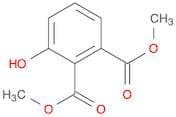
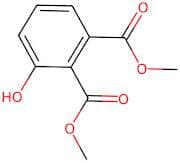
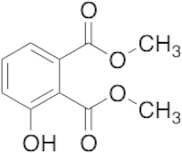
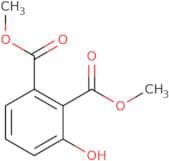
CAS 36669-02-0
:1,2-Benzoldicarbonsäure, 3-hydroxy-, Dimethylester
Beschreibung:
1,2-Benzoldicarbonsäure, 3-hydroxy-, Dimethylester, allgemein bekannt als Dimethyl-3-Hydroxyphthalat, ist eine organische Verbindung, die durch ihre Esterfunktionalgruppen und eine Hydroxylgruppe, die an einen Benzolring gebunden ist, gekennzeichnet ist. Diese Verbindung weist zwei Carboxylatgruppen auf, die mit Methanol verestert sind, was zu ihrer dimethylesterischen Form führt. Sie ist typischerweise eine farblose bis blassgelbe Flüssigkeit oder ein Feststoff, abhängig von Temperatur und Reinheit. Die Anwesenheit der Hydroxylgruppe trägt zu ihrer Löslichkeit in polaren Lösungsmitteln bei, während die aromatische Struktur Stabilität und Potenzial für verschiedene chemische Reaktionen bietet. Diese Verbindung wird häufig in der Synthese anderer organischer Materialien sowie in Anwendungen wie Weichmachern, Lösungsmitteln und Zwischenprodukten in der organischen Synthese verwendet. Ihre chemischen Eigenschaften umfassen eine moderate Flüchtigkeit und Reaktivität, was sie für verschiedene industrielle Anwendungen geeignet macht. Sicherheitsdaten sollten für Handhabungs- und Expositionsrichtlinien konsultiert werden, wie bei jeder chemischen Substanz.
Formel:C10H10O5
Sortieren nach
Reinheit (%)
0
100
|
0
|
50
|
90
|
95
|
100
5 Produkte.
Dimethyl 3-hydroxyphthalate
CAS:Formel:C10H10O5Reinheit:98%Farbe und Form:SolidMolekulargewicht:210.1834dimethyl 3-hydroxyphthalate
CAS:Formel:C10H10O5Reinheit:98%Farbe und Form:SolidMolekulargewicht:210.185Dimethyl 3-Hydroxyphthalate
CAS:Kontrolliertes ProduktApplications Dimethyl 3-Hydroxyphthalate is used as a reactant in the synthesis of proteolysis targeting chimeras.
References Schiedel, Matthias, et al.: J. of Med. Chem., 61(2), 482-491 (2018); Lebraud, Honorine, et al.: ACS Cent. Sci., 2(12), 927-934 (2016);Formel:C10H10O5Farbe und Form:NeatMolekulargewicht:210.18Dimethyl 3-hydroxyphthalate
CAS:Dimethyl 3-hydroxyphthalate is a compound that is used in the production of phthalic acid esters. It can be synthesized by reacting chlorine with phthalic anhydride. The reaction system consists of aqueous solution of dimethyl 3-hydroxyphthalate, chlorine, and water. The electrons are accepted by chloride ions and the reaction proceeds through an electron transfer mechanism. Dimethyl 3-hydoxyphthalate undergoes desorption and spin resonance spectroscopy to determine its kinetic properties. Radical species are generated during the process and these radicals may react with other molecules to form new compounds, leading to mineralization or process efficiency. Phthalic acid esters are produced from this compound by oxidative polymerization reactions.Formel:C10H10O5Reinheit:Min. 95%Molekulargewicht:210.18 g/mol