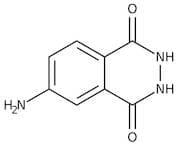
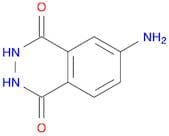
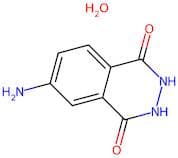
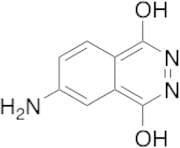
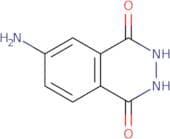
CAS 3682-14-2
:4-Aminophthalhydrazid
Beschreibung:
4-Aminophthalhydrazid, mit der CAS-Nummer 3682-14-2, ist eine organische Verbindung, die durch ihre Hydrazid-Funktionalgruppe gekennzeichnet ist, die an ein Derivat der Phthalsäure gebunden ist. Diese Verbindung erscheint typischerweise als kristalliner Feststoff und ist bekannt für ihre potenziellen Anwendungen in verschiedenen Bereichen, einschließlich der Farbstoffsynthese und als Zwischenprodukt in der organischen Synthese. Sie weist eine Aminogruppe (-NH2) auf, die ihre Reaktivität erhöht, was sie nützlich für die Bildung von Azofarben und anderen komplexen organischen Molekülen macht. Das Vorhandensein sowohl der Hydrazid- als auch der Aminofunktionalitäten ermöglicht eine vielfältige chemische Reaktivität, einschließlich nucleophiler Substitutionen und Kupplungsreaktionen. Darüber hinaus kann 4-Aminophthalhydrazid spezifische Löslichkeitseigenschaften aufweisen, da sie oft in polaren Lösungsmitteln löslich ist, während sie in unpolaren Lösungsmitteln eine begrenzte Löslichkeit zeigt. Sicherheitsdaten weisen darauf hin, dass, wie viele organische Verbindungen, sie mit Vorsicht behandelt werden sollte, da sie bei Exposition Gesundheitsrisiken darstellen kann. Insgesamt ist 4-Aminophthalhydrazid eine vielseitige Verbindung mit erheblicher Relevanz in der synthetischen organischen Chemie.
Formel:C8H9N3O3
InChl:InChI=1/C8H7N3O2.H2O/c9-4-1-2-5-6(3-4)8(13)11-10-7(5)12;/h1-3H,9H2,(H,10,12)(H,11,13);1H2
SMILES:c1cc2c(cc1N)c(nnc2O)O.O
Synonyme:- 6-Amino-2,3-dihydro-1,4-phthalazinedione
- 6-Amino-2,3-Dihydrophthalazine-1,4-Dione
- 6-Amino-2,3-Dihydrophthalazine-1,4-Dione Hydrate (1:1)
Sortieren nach
Reinheit (%)
0
100
|
0
|
50
|
90
|
95
|
100
7 Produkte.
Isoluminol [Chemiluminescence reagent]
CAS:Formel:C8H7N3O2Reinheit:>98.0%(T)(HPLC)Farbe und Form:Light yellow to Amber to Dark green powder to lumpMolekulargewicht:177.164-Aminophthalhydrazide, 98%
CAS:A chemiluminescent moleculeFormel:C8H7N3O2Reinheit:98%Farbe und Form:Pale yellow, PowderMolekulargewicht:177.161,4-Phthalazinedione, 6-amino-2,3-dihydro-
CAS:Formel:C8H7N3O2Reinheit:97%Farbe und Form:SolidMolekulargewicht:177.16014-Aminophthalhydrazide
CAS:Kontrolliertes ProduktApplications 4-Aminophthalhydrazide is a chemiluminescent compound.
References Proskurnina, E. V., et al.: J. Analyt. Chem., 72, 751 (2017); Tian, F., et al.: Guoji Jianyan Yixue Zazhi, 36, 1823 (2015); Ji, X., et al.: Talanta, 150, 666 (2016)Formel:C8H7N3O2Farbe und Form:NeatMolekulargewicht:177.166-Amino-2,3-dihydrophthalazine-1,4-dione
CAS:Formel:C8H7N3O2Reinheit:97%Farbe und Form:SolidMolekulargewicht:177.163Isoluminol
CAS:Isoluminol is a chromogenic molecule with a hydrophilic nature due to the location of the amino group in the phthalate ring, making it impermeable to cell membranes. It is used as a chemiluminescent probe to specifically detect extracellular reactive oxygen species (ROS) metabolites, which are known to be toxic for intra-erythrocytic parasites. Isoluminol-enhanced chemiluminescence has been employed as a sensitive method to study the release of superoxide anion from human neutrophils. Additionally, isoluminol has been utilized to measure extracellular ROS, distinguishing it from luminol, which is used to measure total ROS. Furthermore, isoluminol is suggested to detect mainly extracellular production of ROS, providing a lower chemiluminescence signal compared to luminol. Isoluminol is used as a chemiluminescence amplifier with pronounced affinity to oxidants outside polymorphonuclear leukocytes (PMNLs). It has been reported that isoluminol is less able to traverse biological membranes, making it suitable for detecting the release of NADPH oxidase-derived superoxide ions. Moreover, isoluminol is more hydrophilic and polar than luminol, as indicated by its lower capacity to form intramolecular hydrogen bridges. The molecule's impermeability ensures that only extracellularly excreted ROS are detected in the assay. In analytical chemistry, isoluminol is used as a chemiluminescence probe for labeling proteins and biomolecules, and its chemiluminescent oxidation is enhanced in the presence of certain catalysts. Isoluminol is also employed in open-tubular capillary chromatography systems for the elution of labeled biomolecules. Additionally, isoluminol has been used in microchip chromatography for the analysis of biomolecules.Formel:C8H7N3O2Reinheit:Min. 95%Molekulargewicht:177.05383
![Isoluminol [Chemiluminescence reagent]](/_next/image/?url=https%3A%2Fstatic.cymitquimica.com%2Fproducts%2F3B%2Fthumb%2FA5300.jpg&w=3840&q=75)