

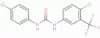
CAS 369-77-7
:Halogenkohlenwasserstoff
Beschreibung:
Die chemische Substanz, die als Halogenkohlenwasserstoff bekannt ist und die CAS-Nummer 369-77-7 trägt, ist eine Art von Organohalogenverbindung. Sie enthält typischerweise Kohlenstoffatome, die an Halogenatome wie Chlor, Brom oder Fluor gebunden sind. Halogenkohlenstoffe zeichnen sich durch ihre vielfältigen chemischen Eigenschaften aus, die je nach spezifischem Halogen und der vorhandenen Kohlenstoffstruktur erheblich variieren können. Sie werden häufig in verschiedenen industriellen Anwendungen eingesetzt, unter anderem als Lösungsmittel, Kältemittel und in der Herstellung von Arzneimitteln. Halogenkohlenstoffe können je nach ihrer molekularen Struktur unterschiedliche Grade von Stabilität, Flüchtigkeit und Reaktivität aufweisen. Einige Halogenkohlenstoffe sind für ihre Umweltauswirkungen bekannt, insbesondere diejenigen, die zur Ozonabbau beitragen oder ein hohes Treibhauspotenzial haben. Sicherheitsüberlegungen sind entscheidend beim Umgang mit Halogenkohlenstoffen, da sie giftig oder schädlich für die menschliche Gesundheit und die Umwelt sein können. Geeignete Lagerungs- und Entsorgungsmethoden sind unerlässlich, um die mit diesen Verbindungen verbundenen Risiken zu mindern.
Formel:C14H9Cl2F3N2O
InChl:InChI=1/C14H9Cl2F3N2O/c15-8-1-3-9(4-2-8)20-13(22)21-10-5-6-12(16)11(7-10)14(17,18)19/h1-7H,(H2,20,21,22)
InChI Key:InChIKey=ZFSXZJXLKAJIGS-UHFFFAOYSA-N
SMILES:N(C(NC1=CC=C(Cl)C=C1)=O)C2=CC(C(F)(F)F)=C(Cl)C=C2
Synonyme:- 1-(4-Chlorophenyl)-3-[4-Chloro-3-(Trifluoromethyl)Phenyl]Urea
- 3-(Trifluoromethyl)-4,4′-dichlorocarbanilide
- 3-Trifluoromethyl-4,4′-dichloro-N,N′-diphenylurea
- 4,4'-Dichlro-3-(trifluoromethyl)carbanilide
- 4,4′-Dichloro-3-(trifluoromethyl)carbanilide
- 44Dichloro3Trifluoromethylcarbanilide
- Carbanilide, 4,4′-dichloro-3-(trifluoromethyl)-
- Cloflucarban
- Clofucarban
- Irgasan CF<sub>3</sub>
- Irgosan CF3
- N-(4-Chlorophenyl)-N'-[4-Chloro-3-(Trifluoromethyl)Phenyl]-Ure
- N-(4-Chlorophenyl)-N-[4-chloro-3-(triflu-romethyl)phenyl]-ures
- N-(4-Chlorophenyl)-N′-[4-chloro-3-(trifluoromethyl)phenyl]urea
- NSC 114133
- Tfc-
- Trifluoromethyl44Dichlorocarbanilide
- Trifluoromethyldichlorocarbanilide
- Urea, N-(4-chlorophenyl)-N′-[4-chloro-3-(trifluoromethyl)phenyl]-
- Halocarban
- Halocarbon
- N-(3-Trifluoromethyl-4-chlorophenyl)-N'-(4-chlorophenyl)urea
- Weitere Synonyme anzeigen
Sortieren nach
Reinheit (%)
0
100
|
0
|
50
|
90
|
95
|
100
5 Produkte.
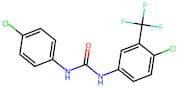
1-(4-Chlorophenyl)-3-[4-chloro-3-(trifluoromethyl)phenyl]urea, 97%
CAS:This Thermo Scientific Chemicals brand product was originally part of the Alfa Aesar product portfolio. Some documentation and label information may refer to the legacy brand. The original Alfa Aesar product / item code or SKU reference has not changed as a part of the brand transition to Thermo SciFormel:C14H9Cl2F3N2OReinheit:97%Molekulargewicht:349.13Halocarban
CAS:Cloflucarban can be used as a disinfectant agent.Formel:C14H9Cl2F3N2OFarbe und Form:SolidMolekulargewicht:349.143-[4-Chloro-3-(trifluoromethyl)phenyl]-1-(4-chlorophenyl)urea
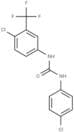
CAS:3-[4-Chloro-3-(trifluoromethyl)phenyl]-1-(4-chlorophenyl)urea is a compound that has been shown to be an antimicrobial agent. It is used in wastewater treatment, where it has been shown to be effective against enterocolitica. 3-[4-Chloro-3-(trifluoromethyl)phenyl]-1-(4-chlorophenyl)urea is also active against other Gram positive and Gram negative bacteria, including methicillin resistant Staphylococcus aureus (MRSA). The mechanism of action is not well understood, but it may work by inhibiting the production of enzymes or by interfering with protein synthesis. This compound can kill bacteria without harming human cells and is biocompatible with living tissue.Formel:C14H9Cl2F3N2OReinheit:Min. 95%Molekulargewicht:349.1 g/mol
![1-(4-Chlorophenyl)-3-[4-chloro-3-(trifluoromethyl)phenyl]urea, 97%](/_next/image/?url=https%3A%2Fstatic.cymitquimica.com%2Fproducts%2F02%2Fthumb%2FH65397.jpg&w=3840&q=75)




![3-[4-Chloro-3-(trifluoromethyl)phenyl]-1-(4-chlorophenyl)urea](/_next/image/?url=https%3A%2Fstatic.cymitquimica.com%2Fproducts%2F3D%2Fthumb%2FAAA36977.jpg&w=3840&q=75)
