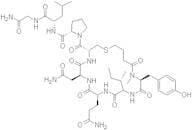
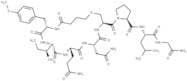
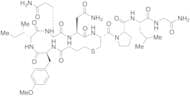
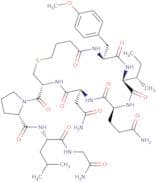
CAS 37025-55-1
:Carbetocin
Beschreibung:
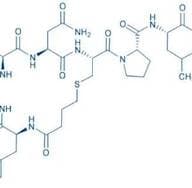
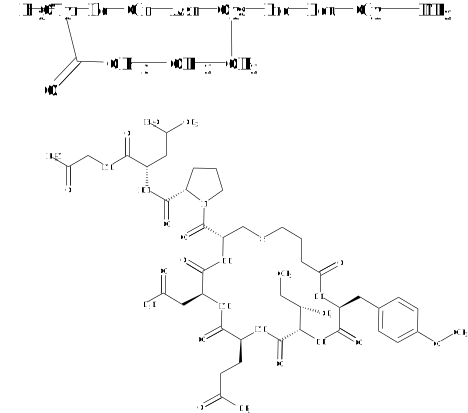
Carbetocin ist ein synthetisches Analogon von Oxytocin, einem Peptidhormon, das eine entscheidende Rolle in verschiedenen physiologischen Prozessen spielt, einschließlich Geburt und Stillzeit. Es ist durch seine Struktur gekennzeichnet, die aus einer Kette von neun Aminosäuren besteht, ähnlich der von Oxytocin, jedoch mit einer Modifikation, die seine Stabilität verbessert und seine Wirkung im Körper verlängert. Carbetocin wird hauptsächlich in klinischen Einrichtungen eingesetzt, um uterine Atonie zu verhindern und die postpartale Blutung nach Kaiserschnitten zu reduzieren. Sein Wirkmechanismus umfasst die Stimulation von Uteruskontraktionen und die Förderung des Milchejektion während des Stillens. Die Substanz wird durch Injektion verabreicht, und ihre Pharmakokinetik wird von Faktoren wie Dosierung und Verabreichungsweg beeinflusst. Carbetocin wird im Allgemeinen gut vertragen, kann jedoch wie jedes Medikament Nebenwirkungen haben, einschließlich Übelkeit, Kopfschmerzen und potenziellen allergischen Reaktionen. Die Anwendung ist in bestimmten Bedingungen kontraindiziert, wie z.B. Überempfindlichkeit gegenüber dem Medikament oder seinen Bestandteilen. Insgesamt stellt Carbetocin ein wichtiges therapeutisches Mittel in der geburtshilflichen Versorgung dar.
Formel:C45H69N11O12S
InChl:InChI=1/C45H69N11O12S/c1-6-25(4)38-44(67)50-28(15-16-34(46)58)40(63)51-30(21-35(47)59)41(64)53-31(23-69-18-8-10-37(61)55(5)33(43(66)54-38)20-26-11-13-27(57)14-12-26)45(68)56-17-7-9-32(56)42(65)52-29(19-24(2)3)39(62)49-22-36(48)60/h11-14,24-25,28-33,38,57H,6-10,15-23H2,1-5H3,(H2,46,58)(H2,47,59)(H2,48,60)(H,49,62)(H,50,67)(H,51,63)(H,52,65)(H,53,64)(H,54,66)/t25-,28-,29-,30-,31-,32-,33-,38-/m0/s1
SMILES:CC[C@H](C)[C@H]1C(=N[C@@H](CCC(=N)O)C(=N[C@@H](CC(=N)O)C(=N[C@@H](CSCCCC(=O)N(C)[C@@H](Cc2ccc(cc2)O)C(=N1)O)C(=O)N1CCC[C@H]1C(=N[C@@H](CC(C)C)C(=NCC(=N)O)O)O)O)O)O
Synonyme:- 1-{[(3R,6S,9S,12S,15S)-6-(2-Amino-2-oxoethyl)-9-(3-amino-3-oxopropyl)-12-[(2S)-butan-2-yl]-15-(4-hydroxybenzyl)-16-methyl-5,8,11,14,17-pentaoxo-1-thia-4,7,10,13,16-pentaazacycloicosan-3-yl]carbonyl}-L-prolyl-L-leucylglycinamide
- glycinamide, 1-[[(3R,6S,9S,12S,15S)-6-(2-amino-2-oxoethyl)-9-(3-amino-3-oxopropyl)-15-[(4-hydroxyphenyl)methyl]-16-methyl-12-[(1S)-1-methylpropyl]-5,8,11,14,17-pentaoxo-1-thia-4,7,10,13,16-pentaazacycloeicos-3-yl]carbonyl]-L-prolyl-L-leucyl-
- (Butyryl1,Tyr(Me)2)-1-Carbaoxytocin Trifluoroacetate Salt;
- [2-O-Methyltyrosine]-deamino-1-carba-oxytocin
- 1-Carbaoxytocin, 1-butanoic acid-2-(O-methyl-L-tyrosine)-
- Carbetocine
- Carbetocino
- Deamino-2-O-methyltyrosine-1-carbaoxytocin
- Depotocin
- CarbetocinAcetate
Sortieren nach
Reinheit (%)
0
100
|
0
|
50
|
90
|
95
|
100
8 Produkte.
Carbetocin
CAS:This synthetic oxytocin analog shows a prolonged effect due to an increased resistance to enzymatic cleavage. Carbetocin is highly effective in preventing post-partum hemorrhage after vaginal delivery.Formel:C45H69N11O12SReinheit: 95.6%Farbe und Form:White LyophilisateMolekulargewicht:988.18Carbetocin acetate
CAS:Formel:·16(freebase)Reinheit:≥ 93.0%Farbe und Form:White to off-white powder or solidCarbetocin Acetate
CAS:Formel:C45H69N11O12SReinheit:95%~99%Farbe und Form:White to Off-white PowderMolekulargewicht:988.18Carbetocin
CAS:Carbetocin is an obstetric drug used to control postpartum hemorrhage and bleeding after giving birth.Formel:C45H69N11O12SReinheit:99.96%Farbe und Form:SolidMolekulargewicht:988.16Carbetocin
CAS:Applications An obstetric drug used to control postpartum hemorrhaging.
References Sanz-Nebot, V., et al.: Anal. Bioanal. Chem., 377, 306 (2003), Gimpl, G., et al.: Eur. J. Pharmacol., 510, 9 (2005), Handler, J., et al.: Theriogenol., 66, 1397 (2006), Klenerova, V., et al.: J. Physiol. Pharmacol., 60, 57 (2009),Formel:C45H69N11O12SFarbe und Form:NeatMolekulargewicht:988.161-Butanoic acid-2-(O-methyl-L-tyrosine)-1-carbaoxytocin
CAS:1-Butanoic acid-2-(O-methyl-L-tyrosine)-1-carbaoxytocin (BMT) is a synthetic analog of oxytocin. Oxytocin is a hormone that is produced in the hypothalamus and released by the pituitary gland to stimulate uterine contractions and milk letdown in mammals. 1-Butanoic acid-2-(O-methyl-L-tyrosine)-1-carbaoxytocin has been shown to bind to the oxytocin receptor and stimulate the release of insulin, which may be useful for treating type 2 diabetes. BMT also stimulates epidermal growth factor (EGF) production and induces skin cell growth. It has been used as an animal health drug for stimulating appetite, increasing weight gain, reducing inflammation, and lowering blood pressure.Formel:C45H69N11O12SReinheit:Min. 95%Farbe und Form:White PowderMolekulargewicht:988.16 g/mol