CAS 37074-90-1
:b-D-Glucopyranose,6-O-(triphenylmethyl)-, 1,2,3,4-tetraacetat
Beschreibung:
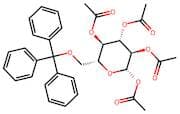
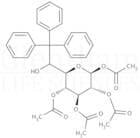
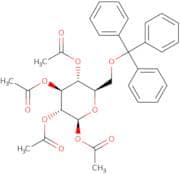
β-D-Glucopyranose, 6-O-(Trityl)-, 1,2,3,4-Tetraacetat ist ein Derivat von Glukose, das speziell an der Position 6 mit einer Tritylgruppe modifiziert und an den Hydroxylgruppen an den Positionen 1, 2, 3 und 4 acetyliert ist. Diese Verbindung zeichnet sich durch ihre komplexe Struktur aus, die ihre Stabilität und Löslichkeit in organischen Lösungsmitteln verbessert. Die Anwesenheit der Tritylgruppe bietet sterische Schutzwirkung, was sie in der organischen Synthese und der Kohlenhydratchemie nützlich macht. Die Tetraacetat-Form zeigt an, dass alle vier Hydroxylgruppen des Glukosemoleküls acetyliert sind, was die Reaktivität der Verbindung und ihre Wechselwirkungen mit anderen Molekülen beeinflussen kann. Diese Modifikation führt in der Regel zu einer erhöhten Lipophilie und einer veränderten biologischen Aktivität im Vergleich zum ursprünglichen Zucker. Die Verbindung wird häufig in synthetischen Wegen zur Herstellung komplexerer Kohlenhydrate oder als Schutzgruppe in Glykosylierungsreaktionen verwendet. Ihre CAS-Nummer, 37074-90-1, ermöglicht eine einfache Identifizierung und Referenz in chemischen Datenbanken.
Formel:C33H34O10
Synonyme:- b-D-Glucopyranose,6-O-(triphenylmethyl)-, tetraacetate (9CI)
- 1,2,3,4-Tetra-O-acetyl-6-O-triphenylmethyl-b-D-glucopyranose
- Nsc 404268
Sortieren nach
Reinheit (%)
0
100
|
0
|
50
|
90
|
95
|
100
3 Produkte.
1,2,3,4-Tetra-O-acetyl-6-O-trityl-β-D-glucopyranose
CAS:1,2,3,4-Tetra-O-acetyl-6-O-trityl-β-D-glucopyranoseReinheit:>98%Molekulargewicht:590.62g/mol1,2,3,4-Tetra-O-acetyl-6-O-triphenylmethyl-b-D-glucopyranose
CAS:1,2,3,4-Tetra-O-acetyl-6-O-triphenylmethyl-b-D-glucopyranose (TATPG) is a carbohydrate that belongs to the family of saccharides. It is a synthetic sugar with a modified glycosidic linkage between the hexoses 1 and 2. The preparation of TATPG is through the modification of sugar with fluorination and glycosylation. TATPG has been used in Click chemistry to attach polymers and proteins to oligosaccharides or monosaccharides. This modification can be achieved through methylation or substitution reactions with other chemical groups such as acetate, phosphates, and thiols. This molecule has also been used in the synthesis of complex carbohydrates by modifying the glucose unit with glucose oxidase, which leads to the formation of D-arabinitol 1,5-.Formel:C33H34O10Reinheit:Min. 95%Farbe und Form:PowderMolekulargewicht:590.62 g/mol