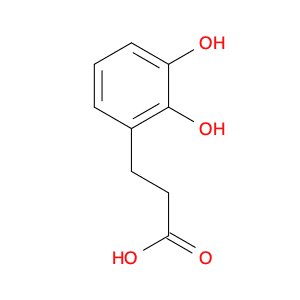
CAS 3714-73-6
:2,3-Dihydroxybenzolpropansäure
- 2,3-Dihydroxybenzenepropanoic acid
- 3-(2,3-Dihydroxyphenyl)propionic acid
- Benzenepropanoic acid, 2,3-dihydroxy-
- Hydrocinnamic acid, 2,3-dihydroxy-
- β-(2,3-Dihydroxyphenyl)propionic acid
2,3-Dihydroxy-benzenepropanoic acid
CAS:Formel:C9H10O4Reinheit:95%Farbe und Form:SolidMolekulargewicht:182.17333-(2,3-Dihydroxyphenyl)propanoic acid
CAS:3-(2,3-Dihydroxyphenyl)propanoic acidReinheit:95%Molekulargewicht:182.17g/mol3-(2,3-Dihydroxyphenyl)propionic acid
CAS:3-(2,3-Dihydroxyphenyl)propionic acid (3-HPP) is a phenolic acid that is produced by the oxidation of 3-hydroxybenzoic acid. It was found to have antimicrobial activity against Pseudomonas aeruginosa and Staphylococcus aureus. The mechanism of action for 3-HPP is not entirely clear, but it may inhibit the growth of bacteria by interfering with the cell membrane or lysis. This compound has been shown to be able to block disulfiram treatment in rats and increase their blood alcohol levels. Disulfiram treatment is an effective drug used in the management of chronic alcoholism and alcohol abuse. 3-HPP has also been shown to inhibit uv absorption in wild type strains of yeast and may be used as a carbon source for these organisms.
Formel:C9H10O4Reinheit:Min. 95%Farbe und Form:PowderMolekulargewicht:182.17 g/mol3-(2,3-Dihydroxyphenyl)propionic Acid
CAS:Kontrolliertes ProduktApplications 3-(2,3-Dihydroxyphenyl)propionic acid is a degradation product of the aromatic compound Phenylpropionate (PP).
References Provencher, S., et al.: Biochemistry, 20, 33 (1981), Ferrandez, A., et al.: J. Bacteriol., 179, 2573 (1997), Torres, B., et al.: J. Biol. Chem., 278, 27575 (2003),Formel:C9H10O4Farbe und Form:NeatMolekulargewicht:182.17