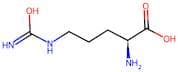
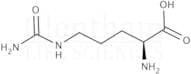
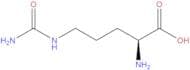
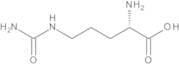
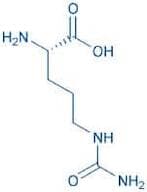
CAS 372-75-8
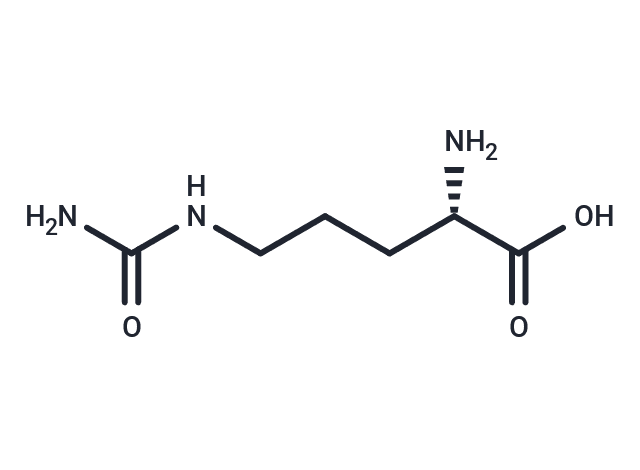
:L(+)-Citrullin
Beschreibung:
L(+)-Citrullin ist eine nicht essentielle Aminosäure, die eine bedeutende Rolle im Harnstoffzyklus spielt und die Entfernung von Ammoniak aus dem Körper erleichtert. Es ist eine farblose, kristalline Substanz, die in Wasser löslich ist und einen leicht süßen Geschmack hat. L(+)-Citrullin kommt natürlich in verschiedenen Lebensmitteln vor, insbesondere in Wassermelonen, und wird auch endogen im Körper produziert. Es ist bekannt für seine potenziellen Vorteile bei der Verbesserung der sportlichen Leistung, der Verbesserung des Blutflusses und der Unterstützung der Herz-Kreislauf-Gesundheit durch Erhöhung der Stickstoffmonoxidwerte. Die Verbindung wird häufig als Nahrungsergänzungsmittel verwendet, insbesondere bei Sportlern und Fitnessbegeisterten, aufgrund ihrer angeblichen Fähigkeit, Muskelkater zu reduzieren und die Erholung zu verbessern. L(+)-Citrullin ist typischerweise sowohl in freier Form als auch als Teil von Dipeptiden oder Proteinen erhältlich. Sein Sicherheitsprofil ist im Allgemeinen günstig, mit wenigen berichteten Nebenwirkungen, wenn es in angemessenen Mengen konsumiert wird. Insgesamt wird L(+)-Citrullin für seine physiologische Bedeutung und potenziellen Gesundheitsvorteile anerkannt.
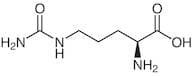
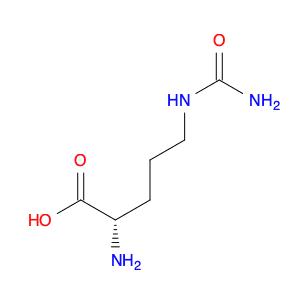
Formel:C6H13N3O3
InChl:InChI=1S/C6H13N3O3/c7-4(5(10)11)2-1-3-9-6(8)12/h4H,1-3,7H2,(H,10,11)(H3,8,9,12)/t4-/m0/s1
InChI Key:InChIKey=RHGKLRLOHDJJDR-BYPYZUCNSA-N
SMILES:C(CCNC(N)=O)[C@@H](C(O)=O)N
Synonyme:- <span class="text-smallcaps">L</span>-(+)-Citrulline
- <span class="text-smallcaps">L</span>-Ornithine, N<sup>5</sup>-(aminocarbonyl)-
- Citrulina
- Citrullin
- Citrulline
- Citrulline, L-
- H-Cit-OH
- L-(+)-2-Amino-5-ureidovaleric acid
- L-Cit-OH
- L-Citrullin
- L-Citrulline (1.12117)
- L-Ornithine, N5-(aminocarbonyl)-
- N5-carbamoyl-L-ornithine
- N<sup>5</sup>-(Aminocarbonyl)-<span class="text-smallcaps">L</span>-ornithine
- N<sup>5</sup>-Carbamoyl-<span class="text-smallcaps">L</span>-ornithine
- N<sup>δ</sup>-Carbamylornithine
- Nsc 27425
- Nδ-Carbamylornithine
- Ornithine, N5-carbamoyl-, L-
- Ornithine, N<sup>5</sup>-carbamoyl-, <span class="text-smallcaps">L</span>-
- α-Amino-δ-ureidovaleric acid
- δ-Ureidonorvaline
- L-(+)-Citrulline
- L-Citrulline
- N5-(Aminocarbonyl)-L-ornithine
- Weitere Synonyme anzeigen
Sortieren nach
Reinheit (%)
0
100
|
0
|
50
|
90
|
95
|
100
19 Produkte.
L-Citrulline
CAS:Formel:C6H13N3O3Reinheit:>98.0%(T)Farbe und Form:White to Almost white powder to crystalMolekulargewicht:175.19L-Citrulline, 98%
CAS:L-Citrulline, is used as an essential intermediate in the biosynthesis of nitric oxide from L-arginine . It is also used as a nutritional drink and biochemical reagent. This Thermo Scientific Chemicals brand product was originally part of the Alfa Aesar product portfolio. Some documentation and laFormel:C6H13N3O3Reinheit:98%Farbe und Form:Powder, WhiteMolekulargewicht:175.19L-Citrulline
CAS:Acyclic amides (including acyclic carbamates) and their derivatives and salts thereof, nesoiFormel:C6H13N3O3Farbe und Form:White Crystalline PowderMolekulargewicht:175.09569N5-(Aminocarbonyl)-L-ornithine
CAS:Formel:C6H13N3O3Reinheit:97%Farbe und Form:SolidMolekulargewicht:175.1857L-Citrulline
CAS:L-CitrullineReinheit:98%Farbe und Form: white crystalline powderMolekulargewicht:175.18572g/molL-Citrulline
CAS:Formel:C6H13N3O3Reinheit:98.0 - 102.0 % (dried basis)Farbe und Form:White or almost white crystalline powderMolekulargewicht:175.19(2S)-2-Amino-5-(carbamoylamino)pentanoic Acid (Citrulline)
CAS:Kontrolliertes ProduktFormel:C6H13N3O3Farbe und Form:NeatMolekulargewicht:175.19L-Citrulline
CAS:L-Citrulline is an amino acid derived from ornithine in the catabolism of proline or glutamate and glutamine, or from l-arginine via arginine-citrulline pathwayFormel:C6H13N3O3Reinheit:99.70% - 99.79%Farbe und Form:SolidMolekulargewicht:175.19L-Citrulline
CAS:Kontrolliertes ProduktApplications An amino acid, first isolated from the juice of watermelon, Citrullus vulgaris Schrad., Cucurbitaceae. Used in the treatment of asthenia.
References Kurtz, et al.: J. Biol. Chem., 122, 477 (1938), Rajantie, J., et al.: J. Pediatr., 97, 927 (1980), Carpenter, T.O., et al.: N. Engl. J. Med., 312, 290 (1985),Formel:C6H13N3O3Farbe und Form:NeatMolekulargewicht:175.19L-Citrulline
CAS:L-Citrulline is a non-protein amino acid that is found in plants and animals. It is synthesized from the amino acid arginine and may be converted to L-arginine, which is an important precursor for nitric oxide synthesis. L-Citrulline has been shown to improve myocardial infarct size and reduce the severity of heart failure in rats. The mechanism of action may be due to its ability to increase ATP production and preserve mitochondrial function. L-Citrulline also has been shown to have chemiluminescence properties, which can be used as a diagnostic tool for bowel disease. L-Citrulline may also help increase the proliferation of pluripotent cells and promote their differentiation into cardiomyocytes, which could be useful for treating heart diseases.Formel:C6H13N3O3Reinheit:Min. 95%Farbe und Form:White PowderMolekulargewicht:175.19 g/molH-Cit-OH
CAS:M03230 - H-Cit-OH
Formel:C6H13N3O3Reinheit:97%Farbe und Form:SolidMolekulargewicht:175.188L-Citrulline extrapure CHR, 99%
CAS:Formel:C6H13N3O3Reinheit:min. 99%Farbe und Form:White, Crystalline powderMolekulargewicht:175.19L-Citrulline ExiPlus, Multi-Compendial, 99%
CAS:Formel:C6H13N3O3Reinheit:min. 99%Farbe und Form:White, Crystalline powderMolekulargewicht:175.19L-Citrulline-13C5
CAS:Kontrolliertes ProduktFormel:C5CH13N3O3Farbe und Form:NeatMolekulargewicht:180.149H-Cit-OH
CAS:L-citrulline is an intermediate in the biosynthesis of nitric oxide.Formel:C6H13N3O3Reinheit:> 99%Farbe und Form:WhiteMolekulargewicht:175.19