CAS 3739-94-4
:2,6-Pyridindicarbonyl-dichlorid
Beschreibung:
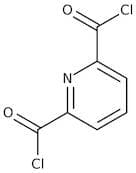
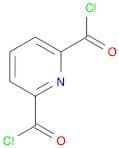
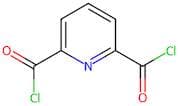
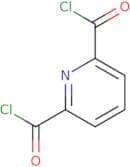
2,6-Pyridindicarbonyl-dichlorid, auch bekannt als 2,6-Pyridinedicarbonsäure-Dichlorid, ist eine organische Verbindung, die durch ihre zwei Carbonylchlorid-Funktionsgruppen, die an einen Pyridinring gebunden sind, gekennzeichnet ist. Diese Verbindung erscheint typischerweise als farblose bis blassgelbe Flüssigkeit oder Feststoff, abhängig von ihrem Zustand und ihrer Reinheit. Sie ist hochreaktiv, insbesondere aufgrund der Anwesenheit der Acylchloridgruppen, die leicht an nucleophilen Substitutionsreaktionen teilnehmen können. Diese Reaktivität macht sie in der organischen Synthese nützlich, insbesondere zur Herstellung von Amiden, Estern und anderen Derivaten. 2,6-Pyridindicarbonyl-dichlorid ist in organischen Lösungsmitteln wie Dichlormethan und Chloroform löslich, jedoch im Allgemeinen unlöslich in Wasser. Sie muss mit Vorsicht behandelt werden, da sie ätzend sein kann und bei Hydrolyse giftige Gase freisetzen kann. Angemessene Sicherheitsvorkehrungen, einschließlich der Verwendung von persönlicher Schutzausrüstung, sind unerlässlich, wenn man mit dieser Verbindung in einem Laborumfeld arbeitet.
Formel:C7H3Cl2NO2
InChl:InChI=1S/C7H3Cl2NO2/c8-6(11)4-2-1-3-5(10-4)7(9)12/h1-3H
InChI Key:InChIKey=GWHOGODUVLQCEB-UHFFFAOYSA-N
SMILES:C(Cl)(=O)C=1N=C(C(Cl)=O)C=CC1
Synonyme:- (2,6-Chlorocarbonyl)pyridine
- 2,6-Bis(chlorocarbonyl)pyridine
- 2,6-Dicarbonylpyridine dichloride
- 2,6-Pyridinedicarbonyl chloride
- 2,6-Pyridinedicarbonyl dichloride
- 2,6-Pyridinedicarboxylic acid dichloride
- Pyridine-2,6-Dicarbonyl Dichloride
- Pyridine-2,6-bis(carbonyl chloride)
- Pyridine-2,6-dicarboxylic chloride
Sortieren nach
Reinheit (%)
0
100
|
0
|
50
|
90
|
95
|
100
5 Produkte.
Pyridine-2,6-dicarbonyl dichloride, 97%
CAS:2,6-Pyridinedicarbonyl dichloride is used as the reagent during the synthesis of pyridine-based polyamido-polyester optically active macrocycles. It is used as starting reagent during the synthesis of pyridine-bridged 2,6-bis-carboxamide Schiff?s bases. It was used in the synthesis of N,N?-bis(1-pyrFormel:C7H3Cl2NO2Reinheit:97%Farbe und Form:Crystals, crystalline powder or fused solid (Chunks and/or Lumps), White to cream to brown or pinkMolekulargewicht:204.012,6-Pyridinedicarbonyl chloride
CAS:Formel:C7H3Cl2NO2Reinheit:95%Farbe und Form:SolidMolekulargewicht:204.01022,6-Pyridinedicarboxylicacidchloride
CAS:2,6-PyridinedicarboxylicacidchlorideReinheit:98%Molekulargewicht:204.01g/mol2,6-Pyridinedicarbonyl dichloride
CAS:2,6-Pyridinedicarbonyl dichloride is an ester that is used as an antimicrobial agent. It inhibits the growth of microorganisms by inhibiting protein synthesis. 2,6-Pyridinedicarbonyl dichloride binds to the ribosome and inhibits the formation of peptide bonds between amino acids. This drug also has antibacterial activity against human pathogens such as Escherichia coli and Staphylococcus aureus. The chemical structure of 2,6-pyridinedicarbonyl dichloride consists of an ester linkage to two nitrogen atoms and one oxygen atom. X-ray crystal structures show that this drug has strong intermolecular hydrogen bonding interactions with other molecules. Reaction mechanism studies have shown that the antimicrobial activity of this drug may be due to its ability to undergo transfer reactions with other molecules in the cell.Formel:C7H3Cl2NO2Reinheit:Min. 95%Molekulargewicht:204.01 g/mol