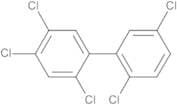
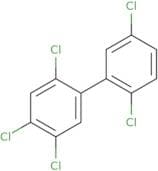
CAS 37680-73-2
:PCB 101
Beschreibung:
PCB 101, oder polychloriertes Biphenyl 101, ist ein Mitglied der Familie der polychlorierten Biphenyle (PCB), die aus synthetischen organischen Chemikalien mit unterschiedlichen Chlorierungsgraden besteht. Charakterisiert durch seine Biphenylstruktur enthält PCB 101 eine spezifische Anordnung von Chloratomen, die seine physikalischen und chemischen Eigenschaften beeinflusst. Typischerweise sind PCBs farb- und lichtgelbe, ölige Flüssigkeiten oder Feststoffe und bekannt für ihre Stabilität, Hitzebeständigkeit und elektrischen Isolierungseigenschaften. PCB 101 ist besonders für seine moderate Toxizität und potenzielle Umweltpersistenz bekannt, was zu einer Bioakkumulation in der Nahrungskette führt. Aufgrund dieser Eigenschaften wurden PCBs, einschließlich PCB 101, in vielen Ländern regulatorischen Prüfungen und Verboten unterzogen, da sie schädliche Auswirkungen auf die menschliche Gesundheit und die Umwelt haben. Sie können eine Reihe von nachteiligen Effekten verursachen, einschließlich endokriner Störungen und Karzinogenität. Der richtige Umgang und die Entsorgung von PCB-haltigen Materialien sind entscheidend, um ihre Auswirkungen auf Ökosysteme und die menschliche Gesundheit zu mindern.
Formel:C12H5Cl5
InChl:InChI=1/C12H5Cl5/c13-6-1-2-9(14)7(3-6)8-4-11(16)12(17)5-10(8)15/h1-5H
InChI Key:InChIKey=LAHWLEDBADHJGA-UHFFFAOYSA-N
SMILES:ClC1=C(C=C(Cl)C(Cl)=C1)C2=C(Cl)C=CC(Cl)=C2
Synonyme:- 1,1'-Biphenyl, 2,2',4,5,5'-Pentachloro-
- 1,1′-Biphenyl, 2,2′,4,5,5′-pentachloro-
- 1,2,4-Trichloro-5-(2,5-dichlorophenyl)benzene
- 2,2',4',5,5'-Pentachlorobiphenyl
- 2,2',4,5,5'-Pcb
- 2,2',4,5,5'-Pentachloro-1,1'-biphenyl
- 2,2′,4,5,5′-Pcb
- 2,2′,4,5,5′-Pentachloro-1,1′-biphenyl
- 2,2′,4,5,5′-Pentachlorobiphenyl
- 2,4,5,2',5'-Pentachlorobiphenyl
- 2,4,5,2′,5′-Pentachlorobiphenyl
- 2,5,2',4',5'-Pentachlorobiphenyl
- 2,5,2′,4′,5′-Pentachlorobiphenyl
- Cb 101
- K 101
- Pcb 101
- 2,2',4,5,5'-Pentachlorobiphenyl
- PCB No 101 solution
- 2,2',4,5,5'-Pentachlorobiphenyl 99% (BZ# 101)
- 2,2’,4,5,5’-Pentachlorobiphenyl Solution in Hexane, 100μg/mL
- 2,2μ,4,5,5μ-PCB, 2,2μ,4,5,5μ-Pentachlorobiphenyl
- 2.2'.4.5.5'-Pentachlorobiphenyl 10mg [37680-73-2]
- PCB101/84
- PCB No. 101 10
- biphenyl,2,2’,4,5,5’-pentachloro-
- 2,2',4,5,5'-Pentachlorobiphenyl-d3
- PCB NO 101
- 2,2μ,4,5,5μ-PCB, 2,2μ,4,5,5μ-Pentachlorobiphenyl solution
- NO 101
- 1,1'-BIPHENYL,2,2',4,5,5'-PEN
- PCB101 in Octane
- BALLSCHMITER NO 101
- BZ NO 101
- 5'-Pentachlorobiphenyl
- Weitere Synonyme anzeigen
Sortieren nach
Reinheit (%)
0
100
|
0
|
50
|
90
|
95
|
100
Dutch Seven PCB Mixture (NEN 5734/VPR C85-16) 10 µg/mL in Isooctane
CAS:Kontrolliertes ProduktFormel:C12H4Cl6Farbe und Form:MixtureMolekulargewicht:360.882,2',4,5,5'-Pentachlorobiphenyl
CAS:Kontrolliertes ProduktFormel:C12H5Cl5Farbe und Form:YellowMolekulargewicht:326.432,2',4,5,5'-Pentachlorobiphenyl
CAS:Kontrolliertes Produkt2,2',4,5,5'-Pentachlorobiphenyl is an environmental pollutant that is not naturally produced. It has been detected in animal tissues and faeces, as well as human tissues and faeces. The metabolite 2,4,5-trichlorophenol has been found to be a precursor of this compound. 2,2',4,5,5'-Pentachlorobiphenyl can persist in the environment for centuries and is difficult to detect because it does not react with many detection methods. This compound has been shown to alter the structure of DNA molecules in animals by inducing mutations in their offspring. The compound also induces changes in the structure of DNA molecules in tissue samples and alters protein synthesis.br>Formel:C12H5Cl5Reinheit:Min. 95%Molekulargewicht:326.43 g/mol